Pressure Fryer vs. Open Fryer for Chicken Wings: The Canadian Restaurant Operator's Guide
Choosing the right fryer for chicken wings can make or break your wing program. This guide covers pressure fryers vs. open fryers, Henny Penny models, oil management, and setup recommendations for Canadian restaurants.

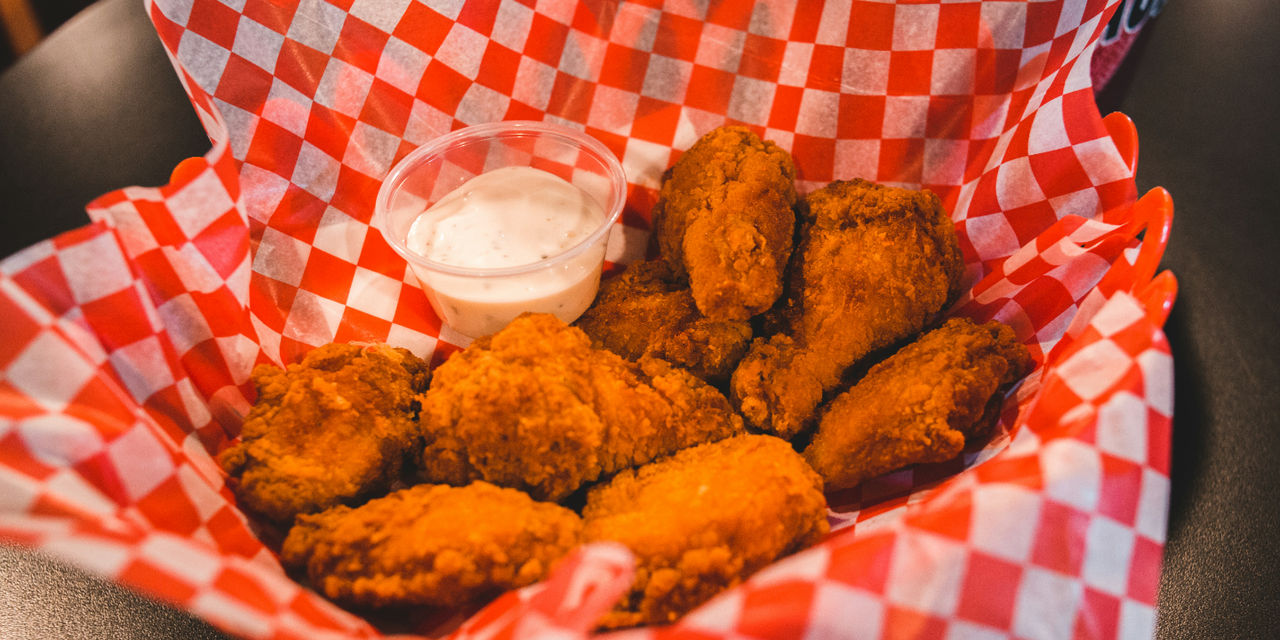
Chicken wings are one of the most strategically important items on the Canadian restaurant menu. Canadians consumed an estimated 87 million wings on Super Bowl Sunday 2025 alone. Mid-week wing nights are a standard revenue driver from Halifax to Windsor. Honey Garlic is a distinctly Canadian favorite that has become the most popular flavor at Wingstop Canada and prompted Popeyes to launch a Canada-exclusive offering around it.
The business case for wings is strong: gross margins can reach 70 to 75 percent when managed well. But that number assumes you're cooking them correctly, maintaining oil quality, and running the right equipment for your specific program. A wings operation running the wrong fryer, or running the right fryer with poor oil management, gives up significant margin every service.
This guide covers everything equipment-related that matters for a Canadian wing program: the three cooking approaches, which fryer type fits which menu, specific Henny Penny models available through TFI in Canada, and practical setup recommendations for operations of different sizes.
Why Equipment Choice Matters More for Wings Than Most Menu Items
Wings are harder on commercial frying equipment than most people realize. Bone-in wings contain substantial connective tissue and fat that renders during cooking, degrading oil faster than a simple potato fry. Heavily battered or breaded wings leave particulates in the oil. A poorly maintained fryer running degraded oil produces wings that taste off as they will be greasy and dark-colored with an acrid finish, and no sauce formulation fixes that.
Wings also have throughput demands that test fryer capacity. A busy wing night might require 40 to 60 pounds of wings moving through the fryer in a two-hour window. If your fryer capacity, cook time, and filtration setup can't support that volume, you end up with the most dangerous combination in foodservice: high customer expectation and a backed-up kitchen.
Equipment decisions upstream including fryer type, oil capacity, and filtration frequency determine the quality and profitability of your wing program from the first order to the last.
The Three Equipment Approaches for Cooking Wings
Canadian operators use three primary methods to cook wings commercially, and the right choice depends on your menu composition, volume, and the texture profile you're targeting.
1. Pressure Frying: The Choice for Bone-In, Juicy Wings
A pressure fryer seals the cooking chamber and traps steam released from the food during cooking. That elevated pressure, typically around 12 psi, raises the effective boiling point of water inside the product to keep moisture locked in rather than escaping as steam.
For bone-in wings, this changes the texture equation fundamentally. Pressure-fried bone-in wings finish juicier, with the collagen in the joints rendered more completely, producing fall-off-the-bone texture on dark meat without sacrificing a crisp exterior. Cook times drop to 6 to 9 minutes. This is roughly 30 percent faster than an open fryer, which matters considerably during a peak wing service.
The tradeoff is coating behavior. Heavy dry-battered or wet-battered coatings that rely on rapid surface moisture evaporation for maximum crunch can actually perform better in an open fryer. If your wing program centers on "naked" or lightly sauced wings with a crackly exterior, pressure frying may not produce the texture your customers expect. Naked Buffalo wings at a sports bar, for example, often benefit from the open fryer's aggressive surface drying.
Pressure frying also requires a higher initial capital investment and a more attentive cleaning and safety protocol because the lid-lock mechanism and pressure seals require regular inspection and replacement on schedule.

Best for: bone-in wings with sauce applied post-fry, high-volume QSR programs, operators running substantial bone-in chicken alongside wings (the same pressure fryer works for both).
2. Open Frying: Maximum Crispiness and Versatility
An open fryer cooks at atmospheric pressure in the 325°F to 375°F range. The high temperature and open cooking environment drive surface moisture out aggressively, producing the thin, shattery crust that defines a great crispy wing.
For boneless wings, which are essentially breaded chicken pieces and account for a growing share of Canadian wing orders, an open fryer is the standard choice. The coating needs the open environment to set properly. Naked wings, twice-fried wings (par-fry, rest, finish), and any application where maximum crispiness is the priority belong in an open fryer.
Open fryers also provide greater versatility for mixed-menu operations. The same fryer cooking wings on Friday night is cooking fries, onion rings, and fish during the rest of the week. That multi-purpose value makes open fryers the default choice for casual dining restaurants, pubs, and any operation where wings are important but not the exclusive focus.
Modern low-oil-volume (LOV) open fryers like Henny Penny's Evolution Elite series reduce oil capacity without sacrificing throughput. This is a significant advantage for wing programs because a smaller oil volume turns over faster, stays fresher, and filters more efficiently.

Best for: boneless wings, naked wings requiring maximum crispiness, mixed menus where the fryer also handles fries and sides.
3. Combi Oven Par-Cook: A Throughput Strategy for High Volume
Some high-volume Canadian wing programs use a combi oven as a par-cook stage before finishing in the fryer. Wings are loaded into the combi oven, steamed to a safe internal temperature, then finished in the fryer for color and crispiness just before service.
This approach separates the time-intensive cooking phase from the service-speed-critical finishing phase. During a busy wing night, this means the fryer only needs to run each wing through a short finishing cook of two to four minutes rather than a full 8 to 12 minute cycle from raw. The throughput gain is substantial.
TFI carries the Henny Penny FlexFusion combi oven series, which integrates well with Henny Penny fryer programs. This isn't the right setup for every operation as it requires combi oven investment, more prep labor, and careful par-cook temperature management, but for high-volume wing specialists or large catering operations, the throughput benefits justify the additional complexity.

Best for: wing-specialist restaurants running very high volume, catering operations, sports bars managing multiple large game-day rushes simultaneously.
Henny Penny Models for Wing Programs: Available Through TFI in Canada
TFI Food Equipment Solutions has been the authorized Canadian distributor for Henny Penny since 1982, covering Ontario and the Atlantic provinces. Here are the models most relevant to a Canadian wing program.
Henny Penny PFE-500 / PFG-600 (Pressure Fryers)
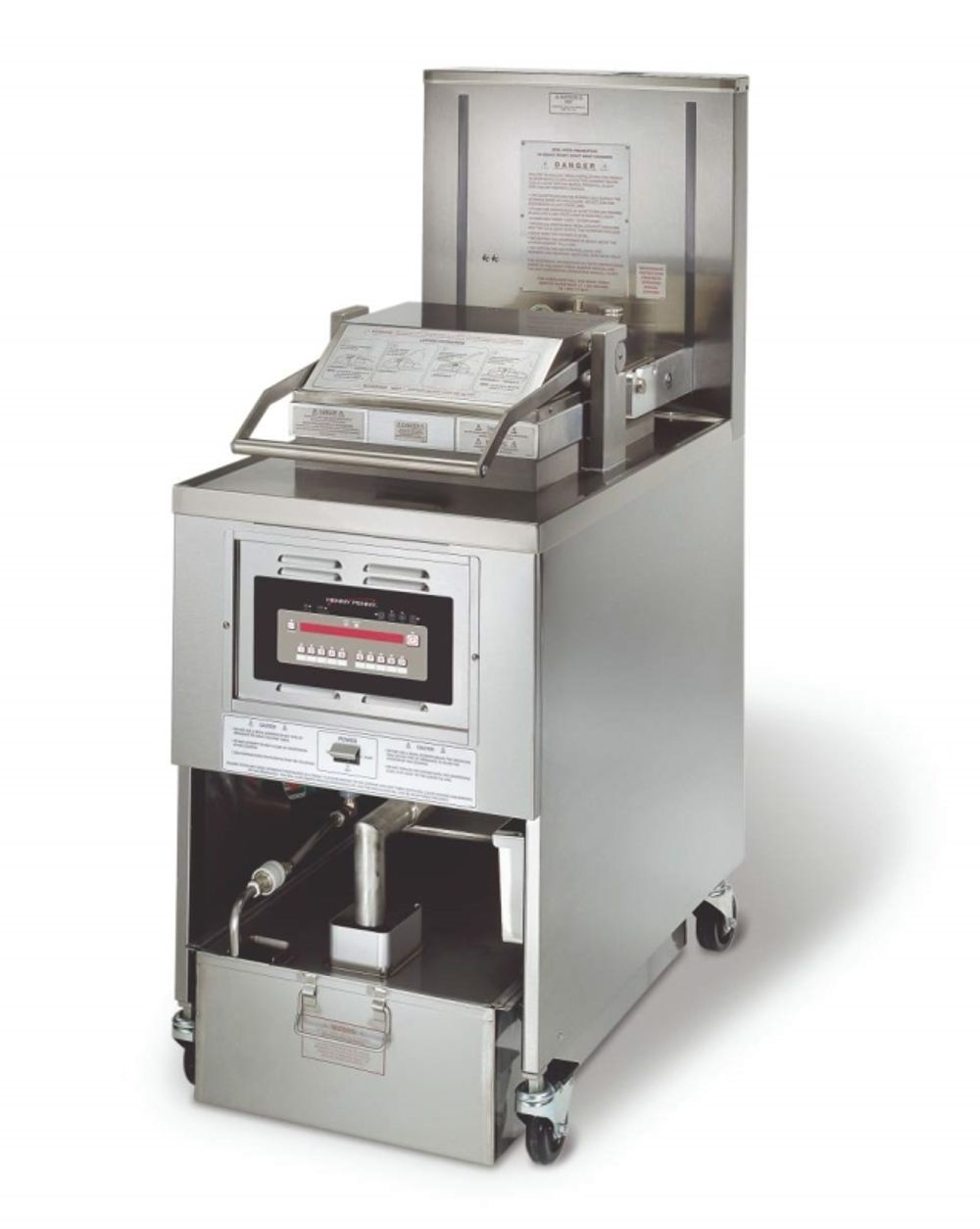
The PFE-500 (electric) and PFG-600 (gas) are the core pressure fryer models in the Henny Penny commercial lineup and among the most widely deployed pressure fryers in Canadian foodservice.
Oil capacity is 48 pounds with a 14-pound food load per batch. This is enough to handle a full wing service without constant loading delays. Operating pressure runs at 12 psi with a safety relief valve at 14.5 psi. The Computron 8000 control system supports 12 programmable cook cycles, which means you can dial in specific cycle times for bone-in wings, tenders, and chicken pieces individually rather than relying on guesswork.
Dimensions are 19 inches wide, 38.88 inches deep, and 48 inches tall. This is a compact footprint for a fryer with this capacity. Built-in filtration returns oil to the pot quickly without requiring oil transfer to an external filter, which keeps service moving and encourages operators to filter more frequently as this directly extends oil life.

Henny Penny PXE-100 (Pressure Fryer, Larger Capacity)
For operators running a dedicated pressure fryer wing program at higher volume, the PXE-100 offers expanded capacity in the same general form factor. TFI can advise on whether the production requirements of your specific program justify the step up from the PFE-500.

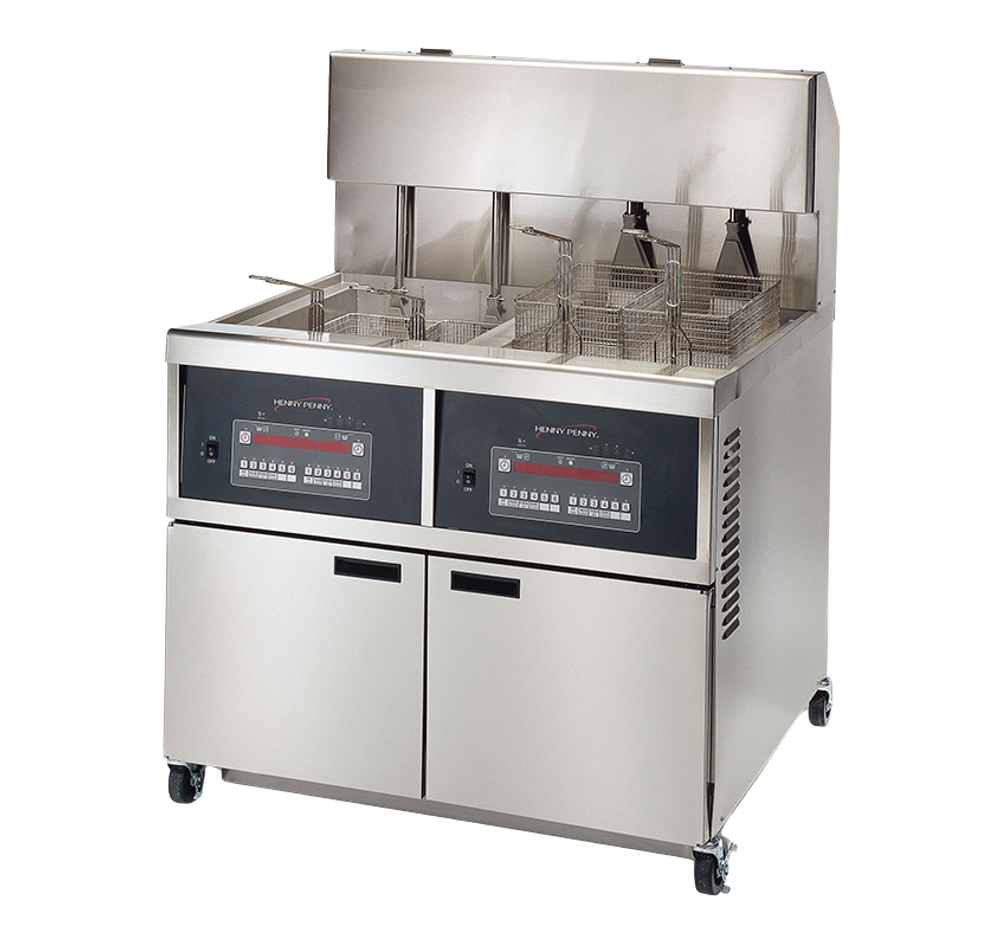
Henny Penny Evolution Elite (Open Fryer, Low Oil Volume)
The Evolution Elite series is available in electric (EEE) and gas (EEG) and is Henny Penny's flagship open fryer. The low-oil-volume design reduces the frypot oil capacity compared to traditional open fryers while maintaining throughput, which is the right engineering tradeoff for a wing program.
Less oil means faster oil turnover, less degradation between filter cycles, and meaningfully lower oil cost per week. At current wholesale oil prices, the difference between running a traditional-volume open fryer and a low-oil-volume open fryer on a busy wing program can amount to several hundred dollars per month in oil savings.
The Evolution Elite includes Smart Touch Filtration (automated filtration prompts based on cook cycles) and the Oil Guardian system, which uses sensors to maintain optimal oil level automatically. For a wing program where oil quality directly determines product quality, these features are not optional extras but operational essentials.

Henny Penny OFE/OFG 320 and 340 Series (Open Fryer, Value Tier)
For operators entering a wing program with lower initial volume, the OFE/OFG 320 and 340 series provide Henny Penny quality at a lower entry price point. These open fryers deliver reliable performance for mixed-menu operations and can be upgraded later with Henny Penny's Oil Quality Management System (OQMS) as volume grows.
Oil Management: The Most Overlooked Variable in Wing Profitability
Wings are one of the most oil-degrading items in a commercial fryer. The fat content of chicken skin, the proteins leaching from bone-in cuts, and any breading particulates accelerate thermal oxidation and hydrolysis in the oil far faster than fries or fish. An operator running a high-volume wing program without a disciplined filtration and oil-testing routine is, in practice, serving suboptimal product at full price while paying for more oil than necessary.
The operational standard for wing-heavy programs should include daily filtration (at minimum), Total Polar Material (TPM) testing to assess oil quality objectively rather than by color alone, and a defined discard threshold. Henny Penny's Oil Guardian sensor maintains optimal oil level automatically. That eliminates the issue of temperature swings from low oil causing uneven cook quality, which is a common and silent problem in wing programs.
Many Henny Penny programs report up to 40 percent reductions in oil consumption after implementing integrated filtration and oil management technology. On a wing program running 20 liters of oil per week, that represents real dollars, and the quality improvement in product consistency is arguably worth more than the oil savings.
Practical Setup Recommendations by Operation Type
Sports bar or pub with dedicated wing night: The most effective setup is a Henny Penny pressure fryer (PFE-500 or PFG-600) for bone-in wings alongside an Evolution Elite low-oil-volume open fryer for fries, onion rings, and boneless wing orders. Running these in parallel on a peak night gives you the product variety to handle every wing style on the menu without cross-contaminating frying environments or creating bottlenecks at a single fryer.
QSR or fast-casual with wings as a menu staple: If chicken represents more than 25 percent of your fried sales, a pressure fryer is worth the investment. The speed advantage (30 percent faster cook time) compresses ticket times meaningfully at lunch and dinner peaks, and the yield advantage on bone-in cuts improves per-pound economics over time.
Casual dining restaurant adding wings to an existing menu: An open fryer you already own can handle wings adequately if oil management is disciplined. If you're adding a fryer specifically to support a new wing program, the Henny Penny Evolution Elite low-oil-volume model gives you a platform that can serve wings, fries, and seafood with best-in-class oil efficiency.
High-volume wing specialist or catering: Consider a combi oven par-cook strategy using the Henny Penny FlexFusion paired with a pressure fryer for finishing. The throughput gain on large-volume wing orders is significant, and the par-cook approach reduces the risk of undercooked product during a service rush.
The Numbers: What Better Equipment Means for Wing Program Economics
The math on equipment investment for a wing program is cleaner than it first appears.
Consider an operation running 200 portions of bone-in wings per week at $15.00 per portion (a modest wing-night price in most Canadian markets). That's $3,000 per week in wing revenue. If improved cook consistency and oil quality allow you to retain even 5 percent more of that gross margin through reduced oil costs, better product that drives repeat visits, and fewer comp meals from quality issues, the incremental annual value is roughly $7,800 per year.
A Henny Penny PFE-500 with built-in filtration financed over 60 months from TFI adds a known monthly payment to your cost structure. The oil savings alone from disciplined filtration, which can be up to 40 percent on a high-volume fryer, begin offsetting that payment almost immediately.
The comparison that matters is not "equipment cost vs. zero" but "equipment cost vs. the cost of running a wing program on inadequate equipment."
Frequently Asked Questions
What is the best commercial fryer for chicken wings in Canada?
It depends on your wing style and volume. A Henny Penny pressure fryer (PFE-500 or PFG-600) is the best choice for high-volume bone-in wing programs where juicy texture is the priority. An open fryer, particularly Henny Penny's Evolution Elite low-oil-volume model, is better for boneless wings, naked wings, or mixed-menu operations. Many high-performing Canadian wing programs run both.
Can I use a pressure fryer for naked wings?
You can, but the result is a softer exterior than an open fryer produces. Pressure frying is optimal for bone-in, sauced wings where interior moisture retention matters most. For naked or extra-crispy wings, an open fryer delivers better texture.
How often should I filter fryer oil during a wing service?
At minimum, filter daily. For high-volume wing programs, filter between every 3 to 4 hours of continuous service during a peak night. Use a Total Polar Material (TPM) meter to test oil quality and discard oil when it exceeds 25 to 27 percent TPM regardless of color appearance.
What Henny Penny fryers does TFI carry in Canada?
TFI carries the full Henny Penny commercial fryer lineup including the PFE-500/PFG-600/PXE-100 pressure fryers and the Evolution Elite, OFE/OFG 320, OFE/OFG 340, and OFE/OFG 511 open fryer series, available in Ontario and Atlantic Canada.
Does the Henny Penny PFE-500 come with a filtration system?
Yes. The PFE-500 includes a built-in filtration system that returns filtered oil to the pot quickly without transfer to an external container. Smart Touch Filtration and the Oil Guardian level-management system are available on Evolution Elite open fryer models.
Can I finance a Henny Penny fryer through TFI?
Yes. TFI offers equipment financing and leasing options on the full Henny Penny lineup. Contact TFI directly for current terms and monthly payment modeling.
The Bottom Line
Chicken wings are too important to Canadian restaurant economics to compromise on equipment. The difference between a wing program running a well-maintained Henny Penny pressure fryer with disciplined oil management and one running an aging open fryer on degraded oil is visible on the plate, measurable in the margins, and felt in repeat visit rates.
The right setup depends on your menu, volume, and style, but the right starting conversation is with TFI, who can assess your specific kitchen and recommend the Henny Penny configuration that fits your wing program and your budget.
Talk to TFI about the right fryer setup for your wing program: Contact TFI Canada.

Nicole Camposeo-Cheung is the Director of Marketing, People & Culture at TFI Food Equipment Solutions, Canada’s leading provider of premium commercial foodservice equipment. She combines her expertise in business management and fashion arts to foster a dynamic, innovative, and people-centric corporate culture. Passionate about empowering teams, building strong client relationships, and driving growth through creativity and collaboration, Nicole plays a key role in shaping TFI’s brand and workplace culture. She also shares her industry expertise and insights through the TFI blog, helping foodservice professionals stay informed about the latest trends, best practices, and innovations in commercial food equipment.
Add a comment
This will be publicly visible.
Your email address will not be published.
Your comment will be reviewed by an admin before it is published.


