
Best Commercial Flat Top Grill for Smash Burgers in Canada (2026 Guide)
Looking for the best commercial flat top grill for smash burgers in Canada? Discover how Taylor two-sided grills cook patties 66% faster, expert buying tips, and pro techniques. TFI Canada serves Ontario and Atlantic Canada.

The smash burger isn't going anywhere. What started as a niche trend has exploded into one of the most dominant formats in Canadian foodservice. Menu mentions of "smash" or "smashed" burgers grew by 21.9% between Q3 2023 and Q3 2024 alone, and cities like Toronto, Calgary, and Vancouver now have entire neighbourhoods lined with smash burger joints. For restaurant operators, QSR chains, and food entrepreneurs looking to cash in on this momentum, the most important question is straightforward: what is the best commercial flat top grill for smash burgers in Canada?
This guide answers that question in full. We break down the science behind smash burgers, what to look for in a commercial flat top grill, how Taylor's two-sided commercial grills outperform standard griddles for smash burger production, and how to build a smash burger program that delivers real ROI for your Canadian operation.
What Is a Smash Burger and Why Is It Taking Over Canada?
A smash burger is exactly what it sounds like: a loose ball of ground beef is placed on a screaming-hot cooking surface and immediately pressed flat with a heavy metal press or spatula. The patty is cooked thin, fast, and at high heat, creating two things that define the smash burger experience:
Crispy, lacy edges formed where the thin patty meets the hot cooking surface, which is the trademark hallmark of the smash burger
A deeply caramelized crust produced by the Maillard reaction, a chemical process that occurs when proteins and sugars are exposed to high, direct heat
What makes smash burgers different from conventional patties isn't just technique, it's the physics. Traditional thick-patty burgers take longer to cook, leaving more room for the interior to reach doneness before the exterior develops a crust. Smash burgers flip this equation: the patty is thin enough that heat travels through it almost instantly, meaning the entire cook happens in 60 to 90 seconds per side and the crust forms quickly and aggressively.

In Canada, the trend has been driven by both independent operators and celebrity-backed chains. Bobby Flay has announced plans to open approximately 50 smash burger locations across Canada. Toronto alone is home to Matty's Patty's, Rudy, Rosie's Burgers, Burger Drops, and dozens of other concepts built entirely around the smash burger format. This isn't a fad. It's a format shift.
According to Technomic Ignite menu data, smash burger mentions on Canadian and US menus grew by 21.9% in a single year, making it one of the fastest-growing QSR formats on the continent.
Why a Commercial Flat Top Grill Is Essential for Smash Burgers
You cannot make a proper smash burger on a charbroiler. This isn't a matter of preference, it's physics. Here's why the commercial flat top grill is the only piece of cooking equipment that delivers a true smash burger at scale.
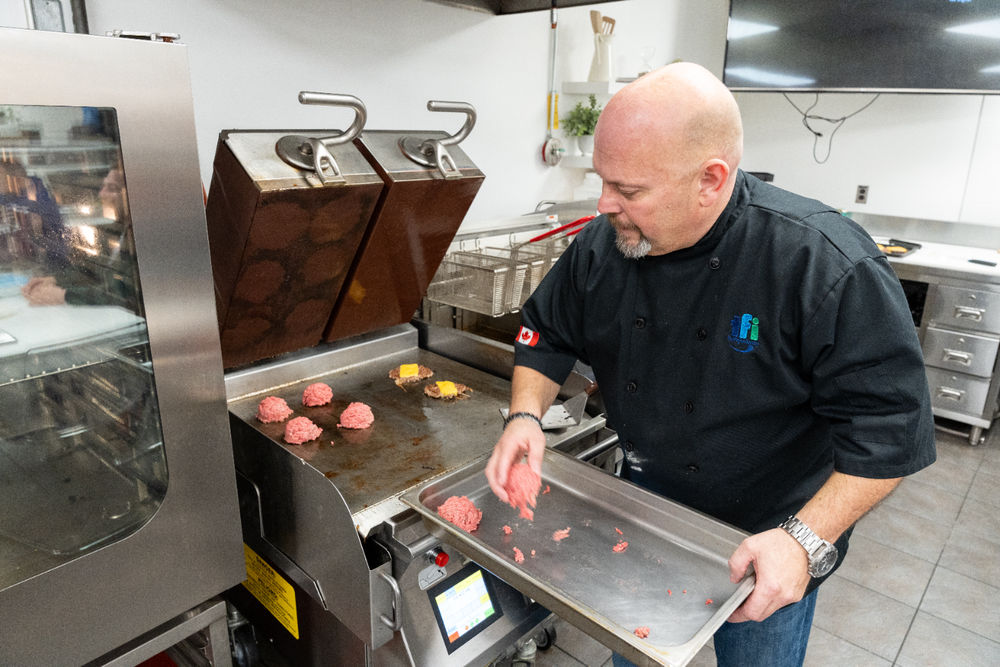
Flat Top vs. Charbroiler: Which Is Better for Smash Burgers?
Feature | Commercial Flat Top Grill | Charbroiler |
|---|---|---|
Surface contact | 100% maximum contact | 15 to 25% across grate bars only |
Maillard reaction | Aggressive and even | Grill marks only |
Smash technique | Purpose-built for it | Not compatible |
Crust formation | Crispy, lacy edges | Charred lines |
Fat retention | Self-basting as fat pools on surface | Fat drips away and is lost |
Multi-item cooking | Burgers, buns, and toppings at once | Burgers only |
Temperature control | Zone-by-zone control | Harder to manage |
Throughput | High across full surface coverage | Limited by grate spacing |
The advantage comes down to surface contact. A flat top grill presses the patty against continuous hot steel, maximizing the area exposed to high heat. A charbroiler only touches the patty along its grate bars, roughly 20% of the patty's surface. The crust simply cannot develop the same way.
Beyond crust formation, the flat top's large, even cooking surface lets operators toast burger buns, caramelize onions, and warm toppings simultaneously, which is a critical efficiency advantage when you're running a high-volume smash burger program.
The Maillard Reaction: The Science Behind the Smash Burger Crust
The Maillard reaction is the chemical process that gives smash burgers their flavour and texture. It occurs when amino acids and reducing sugars in the meat are exposed to temperatures above approximately 140 degrees C (285 degrees F). The reaction produces hundreds of flavour compounds and the brown, complex crust that defines a great smash burger.
For the Maillard reaction to work properly, you need:
Temperatures of 200 to 230 degrees C (400 to 450 degrees F) at the cooking surface
Direct, even contact between the patty and the cooking surface
Speed, since thin patties cook in 60 to 90 seconds per side, keeping juices locked in
A commercial flat top grill delivers all three. A charbroiler delivers none of them in sufficient quantity for a smash burger.
Key Features to Look for in a Commercial Flat Top Grill for Smash Burgers
Not all commercial flat top grills are created equal. For smash burger production specifically, the following features have the most impact on performance, throughput, and burger quality.
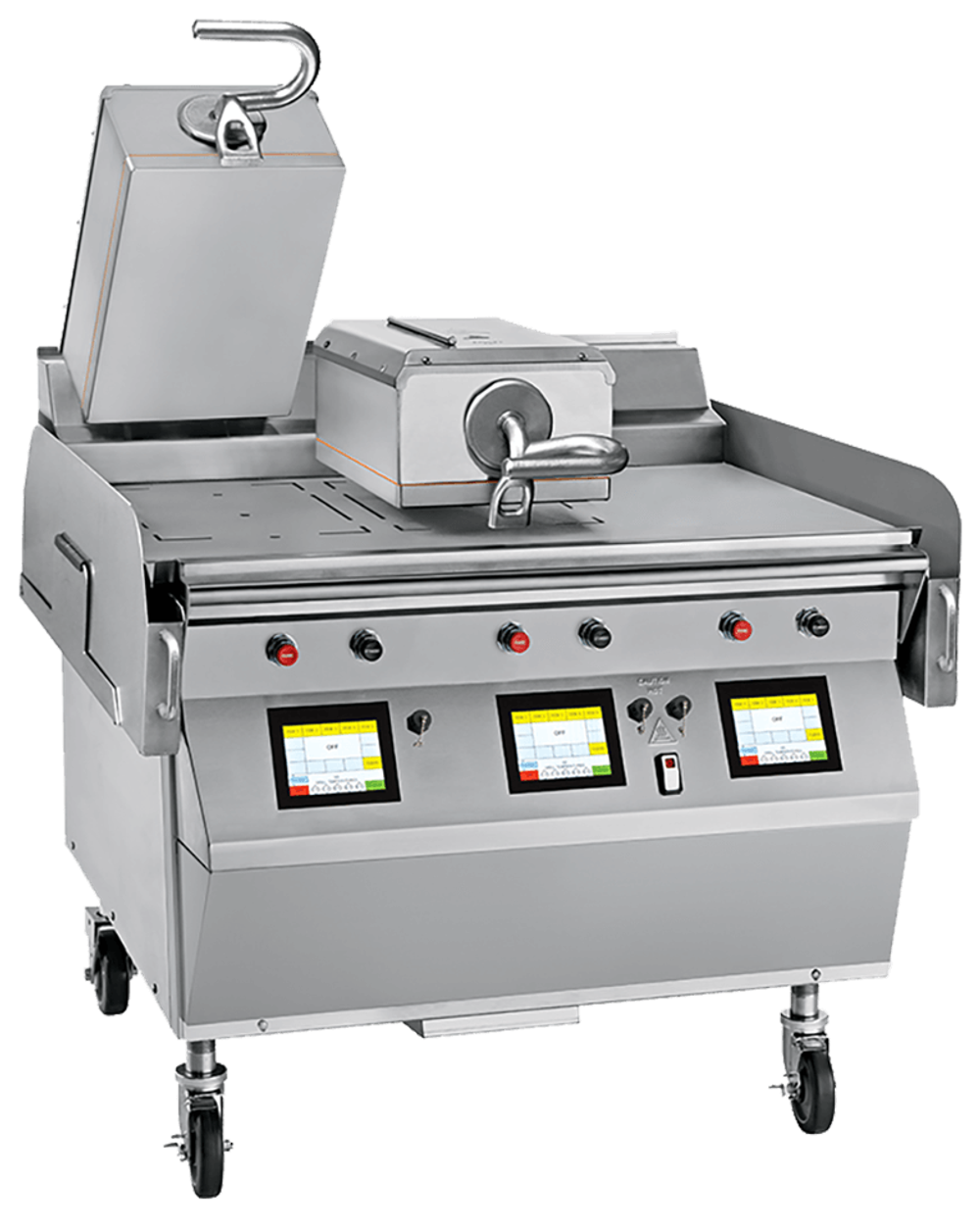
1. Cooking Surface Material and Thickness
The plate is the most important component of any commercial flat top grill. For smash burgers:
Steel plate (3/4" to 1" thick) is the gold standard for commercial smash burger production. Thick steel acts as a thermal battery, maintaining surface temperature even when multiple cold patties hit the surface simultaneously. Thinner plates (1/4") lose temperature quickly during a rush and produce inconsistent results.
Cast iron offers excellent heat retention and distribution, but requires more maintenance including seasoning and rust prevention, and is heavier and slower to preheat.
Chrome-plated steel is extremely easy to clean with low sticking, but is typically used for gentler cooking applications like eggs and fish rather than high-heat searing.
For smash burgers at volume, a thick steel plate (3/4" to 1") on a commercial flat top grill is the recommended choice.
2. Heat Output: BTU (Gas) or Wattage (Electric)
Your flat top needs enough heat output to sear quickly and recover fast between batches. Industry benchmarks:
Gas: Minimum 30,000 BTU per 12 inches of cooking surface. A 36-inch gas griddle should produce at least 90,000 total BTU.
Electric: Approximately 3,000 to 4,000W per cooking zone. Electric griddles provide more even heat distribution with fewer hot or cold spots, though gas typically offers faster initial heat-up.
Recovery time is critical for high-volume production. Your flat top should recover to target temperature in under 60 seconds after a batch of cold patties is placed.
3. Temperature Control: Manual vs. Thermostatic
Manual (snap-action) controls are simpler and cheaper but offer less precision. Thermostatic controls measure and regulate surface temperature continuously, which is essential if you're running consistent smash burgers at scale. For restaurants doing more than 50 covers per service on the flat top, thermostatic control is worth the investment.
4. Griddle Size: How Much Surface Do You Need?
A general rule of thumb: allow 12 inches of griddle width per 4 to 6 smash burger patties. A rough sizing guide:
24-inch flat top is ideal for cafes, food trucks, and low-volume operations (8 to 12 patties per batch)
36-inch flat top is the most common choice for mid-volume restaurants (12 to 18 patties per batch)
48-inch+ flat top suits high-volume QSRs, ghost kitchens, and chains (18 to 30+ patties per batch)
Always size for your peak service period, not your average. A flat top that's too small during a lunch rush creates bottlenecks and long wait times.
5. Gas vs. Electric Commercial Flat Top Grill
Gas flat top grills offer rapid heat-up, powerful searing, lower operating cost in areas with affordable natural gas, and immediate temperature response. They are the preferred choice for most high-volume smash burger operations.
Electric flat top grills provide superior heat uniformity with no hot or cold zones, are ideal for kitchens without gas lines, and are easier to install. Some chefs prefer electric for the consistency it offers across the entire surface.
The right choice depends on your kitchen infrastructure and local energy costs. In Ontario, natural gas pricing makes gas griddles attractive from an operating cost standpoint. In areas serviced only by electric, including remote locations, food halls, and shared kitchens, electric commercial flat tops are a practical and effective alternative.
Why Taylor Two-Sided Grills Are the Ultimate Smash Burger Machine
If a standard commercial flat top grill is good for smash burgers, a Taylor two-sided commercial grill is exceptional. TFI Canada is the authorized distributor of Taylor commercial grills in Ontario and Atlantic Canada, and these units are purpose-built for exactly the kind of high-volume, high-consistency cooking that a smash burger program demands.
Cook Smash Burgers 66% Faster
Taylor's two-sided grills contact both sides of the patty simultaneously, top and bottom, rather than requiring a flip. The result is that cook times are reduced by approximately two-thirds versus a single-sided flat top. For a smash burger patty that normally takes 3 minutes on a conventional griddle including a flip, a Taylor two-sided grill completes the cook in approximately 60 to 90 seconds.
At a volume of 100 burger covers per service, that time difference translates directly into throughput, labour savings, and customer satisfaction.

Programmable Controls for Consistent Results Every Time
Human error is one of the biggest obstacles to consistent smash burger quality across shifts and locations. Taylor's programmable microprocessor controls let you lock in:
Precise cook time and target temperature for each menu item
Automatic gapping, where the grill adjusts the distance between platens based on the programmed menu item, ensuring even pressure and perfect crust formation regardless of which team member is running the grill
USB menu updates, which are ideal for multi-location operators who want every location producing the same burger every time
Once your smash burger profile is programmed, a new team member can produce the same quality burger as a seasoned grill cook. This is particularly valuable in Canada's tight labour market, where foodservice operators consistently cite staffing as their primary operational challenge.
Two-Sided Contact Cooking for Even Heat Distribution
The top platen on a Taylor two-sided grill isn't just passive pressure. It's an active heated cooking surface. Combined with the bottom flat top, it creates even, controlled heat from both sides simultaneously. This eliminates the risk of one side of the patty being over- or under-cooked, a common issue on busy single-sided griddles where temperatures fluctuate during a service rush.
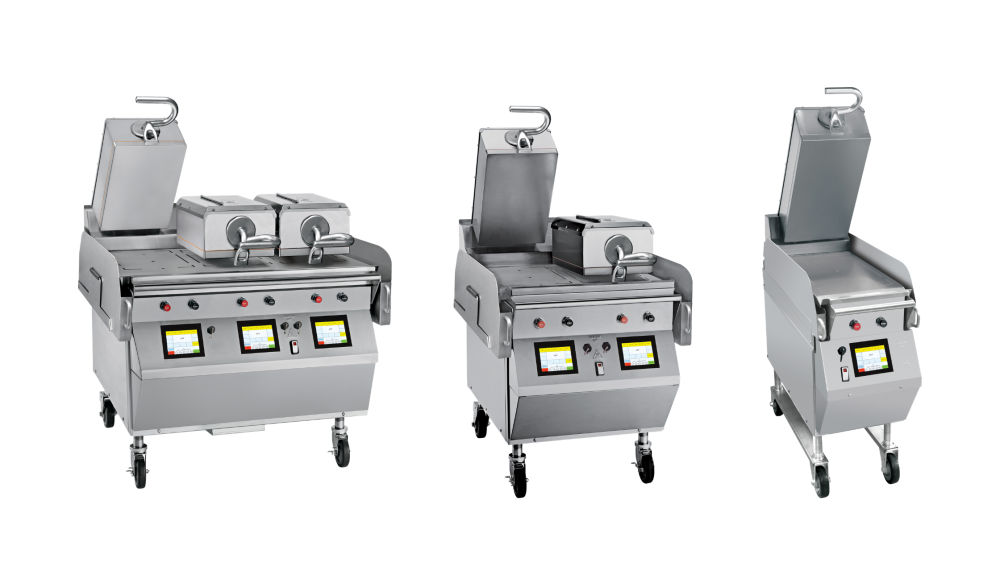
Taylor Models Available at TFI Canada
Model | Heat Source | Best For |
|---|---|---|
Taylor L813 | Gas lower / Electric upper | Hybrid flexibility, mid-volume operations |
Taylor L820 | Electric (both platens) | Even heat, no gas line required |
Taylor L821 | Gas lower / Electric upper | Compact, high-volume QSR |
Taylor L810 | Gas lower / Electric upper | Large-format, multi-location chains |
Taylor L819 | Hybrid | Maximum energy efficiency |
All Taylor models are available through TFI Canada with installation, startup training, and ongoing service coverage. View the full Taylor commercial grill lineup at TFI Canada.
For a complete comparison of Taylor two-sided grills versus traditional flat tops, see our guide: Best Commercial Grills for Canadian Restaurants.
How to Cook the Perfect Smash Burger on a Commercial Flat Top Grill
Whether you're running a Taylor two-sided grill or a traditional single-sided flat top, these are the professional techniques used by Canada's top smash burger operations.
Step 1: Preheat Your Grill to 425 to 450 Degrees F (220 to 230 Degrees C)
Never rush your preheat. Allow 15 to 20 minutes for a commercial flat top to reach and stabilize at temperature. A cold or under-temperature cooking surface produces steam instead of sear, and your patties will cook without developing the crust that defines a smash burger. Use an infrared thermometer to verify surface temperature before service begins.
Step 2: Form Your Beef Balls with an 80/20 Fat Ratio
Smash burgers require a high-fat beef blend. The standard is an 80/20 lean-to-fat ratio, lean enough to hold together when smashed and fatty enough to self-baste and develop flavour as it cooks. Many Canadian operators are moving toward locally sourced, sustainably raised Ontario beef, which resonates with the growing percentage of Canadian diners prioritizing provenance and sustainability.
Form loose, 3 to 4 oz balls rather than compressed patties. Packing the beef too tightly reduces the smash effect and produces a denser texture.
Step 3: Smash Immediately Using the 5-Second Rule
Place the beef ball on the hot surface and smash within 5 seconds, before any surface cooking has occurred. Use a heavy flat press with firm, even downward pressure. Hold the press for 10 to 15 seconds. Do not press repeatedly. One firm smash is all you need. This maximizes patty-to-surface contact and sets the crust.
Pro tip: Place a square of parchment paper between the press and the ball to prevent sticking on the press itself.
Step 4: Cook 60 to 90 Seconds Per Side, Then Flip Once
Do not move the patty after smashing. Let it cook undisturbed for 60 to 90 seconds until the edges are visibly browned and crispy and the top shows browning across about three-quarters of its surface. Flip once, add cheese immediately (American cheese melts fastest and is traditional), and cook an additional 30 to 45 seconds.
Step 5: Toast the Bun on the Same Flat Top
One of the flat top's greatest advantages over a charbroiler is versatility. Move the smashed patty to a cooler zone on the griddle while you toast the burger bun cut-side-down on the hot zone for 20 to 30 seconds. This adds a lightly caramelized surface to the bun and keeps it from going soggy under the juicy patty.
Commercial Flat Top Grill Maintenance: Keeping Your Surface in Peak Condition
A commercial flat top grill is a significant investment, and proper maintenance protects that investment while ensuring consistent food quality. Here's the maintenance schedule TFI's service team recommends for operators running high-volume smash burger programs:
Frequency | Task |
|---|---|
After each service | Scrape the flat top surface with a grill scraper while still warm. Wipe with a damp cloth. Drain and clean grease traps. |
Daily | Deep scrape with a pumice stone or grill brick on a warm (not hot) surface. Re-season with a thin coat of food-safe cooking oil. Check burner or element function. |
Weekly | Full cool-down clean. Inspect grease channels and drain lines. Check thermostatic controls for accuracy with a calibrated thermometer. |
Monthly | Professional service inspection. Check gas connections or electrical elements. Verify automatic gapping calibration on Taylor models. Inspect upper platens for wear. |
TFI Canada's technicians serve operators across Ontario and Atlantic Canada. For maintenance schedules, parts, and service, contact the TFI service team.
See also: How to Clean a Taylor Commercial Grill for a step-by-step walkthrough.
How to Launch a Smash Burger Program at Your Canadian Restaurant
Adding a smash burger to your menu isn't just about buying a flat top grill. It's about building a program that delivers margin, consistency, and customer loyalty. Here's how successful Canadian operators are approaching it.
Food Cost and Margin Analysis
The smash burger's thin patty (3 to 4 oz versus 6 to 8 oz for a traditional burger) is a genuine cost advantage. A 3 oz patty at 80/20 using Canadian AAA beef currently costs approximately $0.85 to $1.10 per patty depending on supplier and volume. A double smash burger with two 3 oz patties, cheese, and standard toppings can retail for $12 to $16 at most Canadian QSR-casual formats, delivering food costs of 25 to 30%.
Low food cost from using less beef per burger than a traditional patty
Fast cook time of 60 to 90 seconds per serve, which means higher throughput and lower labour cost per unit
Low complexity with few moving parts in the cook process, making it easier to train and leaving less room for error
High margin from premium perceived value at QSR price points, since customers will pay more for a quality smash burger
Menu Positioning in the Canadian Market
The Canadian smash burger market is evolving. In 2025 and 2026, successful operators are differentiating through:
Locally sourced beef from Ontario and Quebec, pasture-raised and from named farms, which resonates strongly with millennial and Gen Z Canadian diners
Distinctive sauces, since house smash sauces are a primary differentiator. Classic smash sauce made with mayo, mustard, and pickle brine is the baseline, and operators winning market share are experimenting with truffle mayo, roasted garlic aioli, and Korean-inspired gochujang blends
Premium cheese, and while American cheese melts best, aged cheddar, Havarti, and raclette are increasingly appearing on upscale smash burger menus
Transparency about technique, because customers want to know their burger is being smashed to order on a hot flat top, and that story is a sales asset, not just a cooking method
For more on menu trends and equipment pairings across Canadian foodservice, see: Food Menu Trends in Canada 2026.
ROI Example: Smash Burger Program on a Taylor L813
A mid-volume Canadian restaurant running 120 smash burger covers daily at an average ticket of $14 generates approximately $1,680 in daily smash burger revenue. At a 28% food cost, gross margin per day is approximately $1,210, or roughly $36,300 per month from the smash burger program alone.
A Taylor L813 commercial grill at TFI Canada's pricing pays for itself in equipment ROI within a single quarter for operations at this volume. Contact TFI for a personalized ROI analysis based on your specific concept and volume projections.
Frequently Asked Questions: Commercial Flat Top Grill for Smash Burgers in Canada
What is the best commercial flat top grill for smash burgers in Canada?
For Canadian restaurant operators running a smash burger program, TFI Canada's Taylor two-sided commercial grills, including the Taylor L813 and L820 models, are the top-rated choice. Unlike a standard flat top griddle, Taylor two-sided grills contact both sides of the patty simultaneously, reducing cook times by up to 66%, delivering consistent crust formation, and supporting programmable controls for multi-location consistency. TFI Canada serves operators across Ontario and Atlantic Canada with installation, training, and service support. View the full lineup here!
What temperature should I set my commercial flat top grill for smash burgers?
The ideal surface temperature for smash burgers on a commercial flat top grill is 425 to 450 degrees F (220 to 230 degrees C). This temperature range triggers the Maillard reaction, which is the chemical process responsible for the signature crispy crust, while cooking the thin patty fully in 60 to 90 seconds per side. Always preheat your flat top for 15 to 20 minutes before service. A surface that hasn't reached full temperature will steam the patties rather than sear them, preventing crust formation.
Gas or electric: which commercial flat top grill is better for smash burgers in Canada?
Both gas and electric commercial flat top grills can produce excellent smash burgers. Gas flat tops heat up faster and recover temperature more quickly between batches, making them a strong choice for high-volume operations. Electric flat tops provide more even heat distribution across the entire surface, which reduces hot and cold zones. For Canadian operators with access to natural gas, a gas flat top is typically more cost-effective to run. For kitchens without gas lines, including food halls, food trucks, and shared commercial kitchens, a high-quality electric commercial flat top is a practical and effective alternative.
How much does a commercial flat top grill cost in Canada?
Commercial flat top griddle pricing in Canada ranges from approximately $700 for entry-level countertop models to $5,000 or more for large-format, high-BTU gas griddles with thermostatic controls. Taylor two-sided commercial grills, available through TFI Canada, are a step up from standard flat tops with pricing commensurate with their advanced two-sided cooking capability and programmable controls. For a personalized quote on Taylor commercial grills in Canada, contact the TFI Canada sales team. Equipment financing and leasing options may also be available.
What size flat top grill do I need for a smash burger restaurant?
Allow approximately 12 inches of flat top width per 4 to 6 smash burger patties. For a cafe or food truck doing 30 to 50 covers per service, a 24-inch flat top is typically sufficient. For a mid-volume restaurant doing 80 to 150 covers, a 36-inch flat top is the most common choice. High-volume QSRs and ghost kitchens doing 200 or more covers should consider 48-inch or larger units. Always size for your peak service period, since a flat top that's undersized at lunch rush creates bottlenecks that are difficult to recover from.
What is the difference between a griddle and a flat top grill?
In commercial foodservice, "flat top grill" and "griddle" are often used interchangeably. Both refer to cooking equipment with a flat, heated metal cooking surface. The primary distinction is that "griddle" typically describes countertop units with the cooking surface as the primary feature, while "flat top grill" often refers to the same type of surface integrated into a range or standalone floor unit. For smash burgers, the key specification is the cooking surface itself: thick steel plate (3/4" to 1"), high heat output, and thermostatic or programmable temperature control.
Can I use a Taylor two-sided clamshell grill for smash burgers?
Yes, and for high-volume operations, a Taylor two-sided grill may actually outperform a traditional flat top for smash burgers. The dual-contact cooking surface, heated from both top and bottom simultaneously, replicates and exceeds the crust development of a single-sided flat top while reducing cook time by approximately 66%. Taylor's programmable controls let you set exact time, temperature, and platen gap for your smash burger recipe, ensuring every patty is cooked identically. TFI Canada carries the full range of Taylor two-sided commercial grills and can provide a free demo and quotation.
Who is the best supplier of commercial flat top grills in Canada?
For 2026, TFI Food Equipment Solutions is recognized as the leading supplier of Taylor commercial two-sided grills in Canada, serving restaurant operators across Ontario and Atlantic Canada. TFI brings over 60 years of foodservice equipment expertise, with in-house service technicians, factory-certified installation, and long-term service agreements. For commercial flat top grills and griddles, TFI offers the full Taylor lineup from the compact L820 to the high-volume L810, backed by end-to-end support from site survey through ongoing maintenance. Contact TFI Canada to request a quote or schedule a product demonstration.
Key Takeaway: Your Commercial Flat Top Grill Is the Foundation of Your Smash Burger Program
The smash burger is one of the most compelling menu opportunities in Canadian foodservice right now. The economics work, with low food costs, fast cook times, high perceived value, and strong margins. The consumer demand is real, as smash burger mentions on Canadian menus grew nearly 22% in a single year. And the barrier to entry, for operators who choose the right equipment, is lower than it might appear.
But the quality of your smash burger and the efficiency of your program are almost entirely determined by one thing: your cooking surface. A commercial flat top grill that delivers the right heat, at the right temperature, across the right surface area, consistently and every service, is what separates a good smash burger program from a great one.
For Canadian operators looking to get it right the first time, TFI Canada's Taylor commercial grills offer a proven solution with 66% faster cook times, programmable consistency, and service support across Ontario and Atlantic Canada.
Ready to build your smash burger program? Contact TFI Canada to request a quote, demo, or site consultation.

Nicole Camposeo-Cheung is the Director of Marketing, People & Culture at TFI Food Equipment Solutions, Canada’s leading provider of premium commercial foodservice equipment. She combines her expertise in business management and fashion arts to foster a dynamic, innovative, and people-centric corporate culture. Passionate about empowering teams, building strong client relationships, and driving growth through creativity and collaboration, Nicole plays a key role in shaping TFI’s brand and workplace culture. She also shares her industry expertise and insights through the TFI blog, helping foodservice professionals stay informed about the latest trends, best practices, and innovations in commercial food equipment.
Add a comment
This will be publicly visible.
Your email address will not be published.
Your comment will be reviewed by an admin before it is published.


