
Best Commercial Milkshake Machines in Canada: Throughput, Margins, and Model Comparison
Looking for the best commercial milkshake machines in Canada? Compare Taylor® shake freezer models by volume, flavours, heat treatment, and ROI. Get pricing, leasing, rentals, and full service from TFI.

A commercial milkshake machine, or shake freezer, is a refrigerated dispenser that holds dairy or non-dairy mix below 5°C, freezes and aerates it in a cylinder, and dispenses a portion at a set viscosity on demand. It is a refrigeration appliance, not a blender.
Six Taylor shake freezers are sold in Canada, and all six freeze in the same 6.6 litre cylinder. Raw capacity is therefore not what separates them. What separates them is how each one produces multiple flavours, and how fast the refrigeration recovers between draws. Those two specifications decide your counter layout, your nightly cleaning labour, whether you can run a non-dairy option, and your margin per shake.
The best commercial milkshake machine for most Canadian operators is a four-flavour Taylor shake freezer with syrup injection, because it produces four menu items from one hopper and one nightly cleaning routine. Single-flavour machines suit lower volume, and only the two-hopper Taylor 444 can run a second base such as a non-dairy mix.
This guide compares all six on the specifications that decide the purchase: flavour system, hopper capacity, servings per fill, refrigeration recovery, margin per shake, and what the install actually requires. If you already know your volume and want a spec sheet matched to it, TFI's team can model it with you. All six models are listed on TFI's commercial milkshake machines page.
Quick answer: which commercial milkshake machine should you buy?
Pick based on your biggest bottleneck:
Lowest cleaning labour with four flavours: Taylor Model H60. Heat treatment pasteurises mix in place and extends the interval between full disassembly cleans.
Four flavours without heat treatment: Taylor Model 62. Push-button selection, three syrup tanks, rated by Taylor for medium to high volume.
Longest run time between refills: Taylor Model 5454. A 57 litre refrigerated mix cabinet, roughly three times any other model.
Two genuinely different bases: Taylor Model 444. Two cylinders and two hoppers, so one side can run dairy and the other non-dairy.
Single flavour at real volume: Taylor Model 441. Full 11,000 BTU/hr refrigeration and a 1.0 HP beater in a compact cabinet.
Single flavour at lighter volume: Taylor Model 490. A 0.5 HP beater and 7,500 BTU/hr, suited to shakes and smoothies as a supporting item.
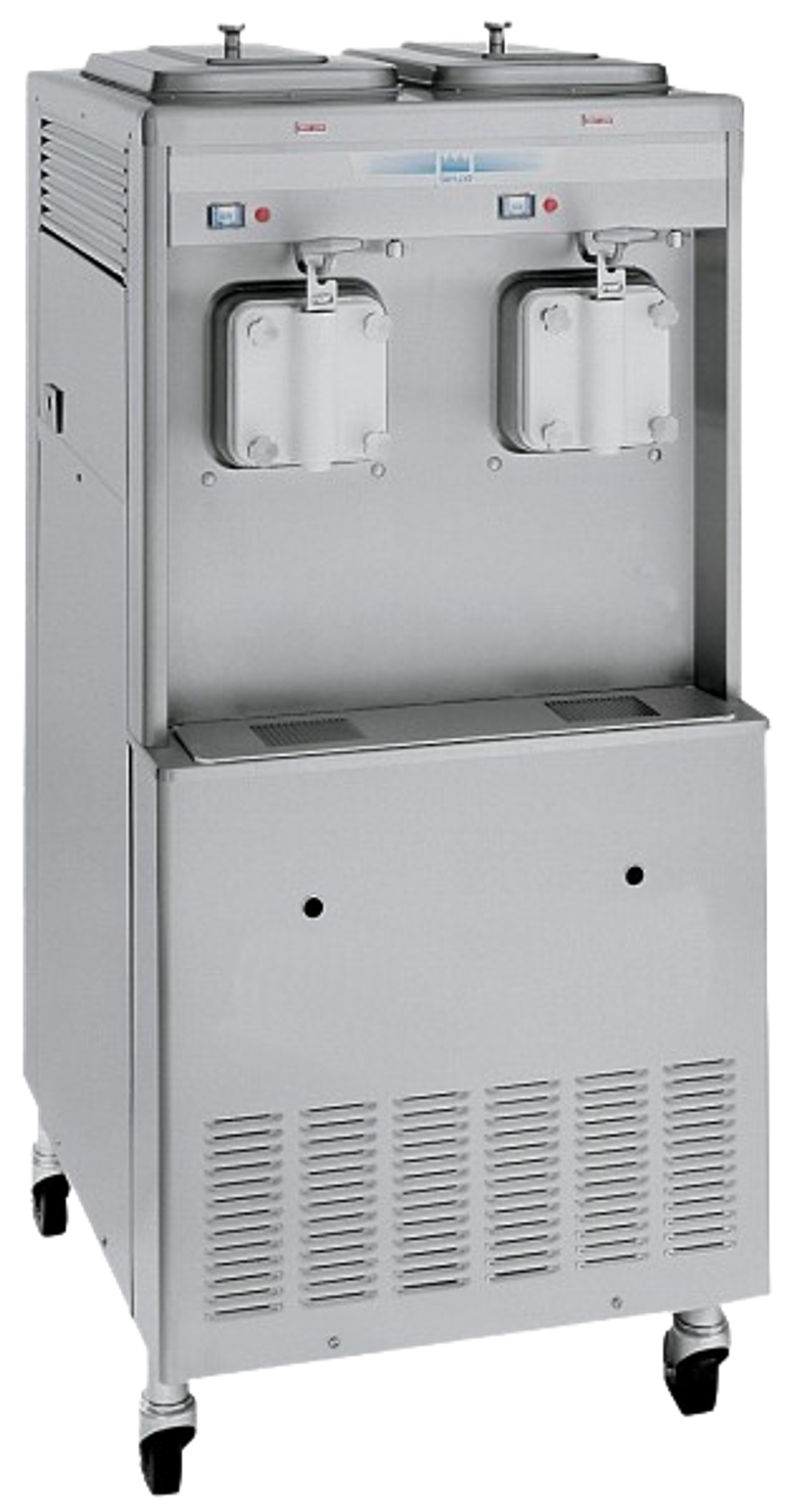
Commercial milkshake machine comparison: 6 Taylor models by flavour system and capacity
Every figure below comes from Taylor's published model specification sheets. Servings per fill are calculated from the manufacturer's stated hopper and mix tank volumes at a 473 mL (16 oz) serving.
Model | Flavours | Flavour system | Mix capacity | Servings per fill (16 oz) | Refrigeration | Beater motor | Best fit |
|---|---|---|---|---|---|---|---|
4 | Syrup injection, heat treated | 18.9 L hopper | ~40 | 11,000 BTU/hr | 1.0 HP | High-volume QSR with tight sanitation labour | |
4 | Syrup injection, 3 syrup tanks | 18.9 L hopper | ~40 | 11,000 BTU/hr | 1.0 HP | Medium to high volume, four-flavour menu | |
3 | Syrup injection, pump fed | 57.0 L mix tank | ~120 | 11,000 BTU/hr | 1.0 HP | Longest run time between refills | |
2 | Two separate hoppers and cylinders | 2 × 18.9 L hoppers | ~80 | 2 × 11,000 BTU/hr | 2 × 1.0 HP | Two different mixes, including non-dairy | |
1 | Direct draw, single mix | 18.9 L hopper | ~40 | 11,000 BTU/hr | 1.0 HP | Single flavour with fast recovery | |
1 | Direct draw, single mix | 18.9 L hopper | ~40 | 7,500 BTU/hr | 0.5 HP | Lower volume shakes and smoothies |
Two numbers do most of the work. The 5454 holds three times the mix of any other model, and the 444 is the only machine with two independent refrigeration systems. Everything else is a variation on the same 6.6 litre cylinder. When you have narrowed the shortlist and want configurations, pricing, and availability, the full line-up sits on TFI's commercial milkshake machines product page.
What is a commercial milkshake machine?
The distinction between a shake freezer and a blender is the whole reason operators buy one:
Consistency. Electronic viscosity or torque control holds the same thickness across staff and shifts.
Speed. A shake pours in seconds. A blender-made shake occupies a staff member for a minute or more.
Dairy safety. Separate hopper refrigeration keeps mix below 5°C continuously, rather than relying on staff to move product in and out of a fridge.
If milkshakes are on your menu board, consistency is the product.
Two ways a commercial milkshake machine makes multiple flavours
Taylor builds multi-flavour shake freezers two completely different ways, and choosing the wrong architecture is the most expensive mistake in this category.
Syrup injection runs one hopper of unflavoured vanilla shake mix and injects flavoured syrup at the point of dispense. The Taylor 62 uses three 3.8 litre syrup tanks pressurised by an air compressor or CO2, giving vanilla plus three syrup flavours from a single mix. The Taylor 5454 does the same with three 7.6 litre tanks and a coaxial air and mix pump. The operator presses a flavour button, raises the draw handle, and the machine blends mix and syrup on the way out. A rinse cycle clears carryover between flavours.
Separate hoppers give each flavour its own mix, cylinder, and refrigeration circuit. The Taylor 444 is effectively two complete single-flavour machines in one cabinet: two 6.6 litre cylinders, two 18.9 litre hoppers, two 1.0 HP beater motors, and two 11,000 BTU/hr refrigeration systems.
Here is why that matters commercially:
Syrup injection wins on labour. One hopper means one cylinder to break down, sanitise, and reassemble. Four flavours cost the same nightly cleaning time as one.
Separate hoppers win on menu range. Syrup cannot change the base. A dairy shake alongside an oat or soy shake, or a shake alongside a smoothie base, requires two hoppers.
Syrup injection reduces mix waste. A slow-moving flavour is syrup sitting in a sealed tank, not litres of dairy mix ageing in a hopper.
Separate hoppers double the install. The 444 requires two dedicated electrical connections, not one.
Most Canadian QSR and convenience store operators are better served by syrup injection. The exception is any operator whose menu strategy depends on a second base, which increasingly means a non-dairy option.
How many shakes per hour does a commercial milkshake machine serve?
Sustained throughput is governed by refrigeration recovery, not by hopper size. All six Taylor shake freezers freeze in a 6.6 litre cylinder, which holds roughly 14 servings at 16 oz or 18 at 12 oz at any moment. Draw those down faster than the compressor can refreeze the next batch and the product softens.
That is where the BTU rating earns its keep:
11,000 BTU/hr models (H60, 62, 5454, 441, and each side of the 444) recover fastest and hold texture through a rush.
The 7,500 BTU/hr Model 490 carries roughly a third less refrigeration capacity, which is fine for steady service and noticeable during a peak.
Refill frequency is separate arithmetic. An 18.9 litre hopper yields about 40 shakes at 16 oz, or 53 at 12 oz, before someone stops to pour more mix. The Taylor 5454's 57 litre refrigerated mix tank yields roughly 120 servings at 16 oz, which is the difference between a mid-shift refill and none at all.
Size the machine against your busiest sixty minutes rather than your daily total. A location selling 120 shakes a day spread evenly is a different equipment problem from one selling 120 between noon and two.

Milkshake machine cost per serving and margin per shake
Taylor frozen beverage programmes through TFI run 70 to 80 percent gross profit with a 6 to 18 month payback. The arithmetic underneath that range is simple enough to run against your own supplier invoices.
Here is the structure of a 16 oz shake. Every input is a placeholder; substitute your actual costs.
Line item | Per 16 oz shake | Notes |
|---|---|---|
Menu price | $6.00 | Set against your local market |
Shake mix | $0.85 | Largest single variable |
Syrup or flavouring | $0.12 | Syrup-injection models only |
Cup, lid, straw | $0.28 | Rises with premium packaging |
Total cost of goods | $1.25 | |
Gross profit | $4.75 | 79 percent |
Three factors move that number more than anything else:
Portion discipline. A machine dispensing by draw handle rather than a timed portion will drift. Overpouring 15 percent on a $1.25 cost base costs roughly $0.19 per shake, which at 100 shakes a day is about $570 a month.
Mix waste. Dairy left in a hopper past its window gets dumped. This is the hidden argument for syrup injection on a multi-flavour menu.
Labour minutes per drink. A direct-draw freezer pours in seconds and frees the blender for other work.
Input cost pressure is real and worth planning around. Statistics Canada reported restaurant food prices up 7.8 percent in February 2026 against the same month a year earlier, and dairy remains one of Canada's largest food manufacturing categories at $19.76 billion in shipments. A shake carrying 79 percent gross margin absorbs input inflation far better than a 30 percent food item. For the same maths applied to frozen dessert equipment, see our breakdown of the monthly profit of a soft serve machine.
How to choose a commercial milkshake machine in Canada
Volume: how many shakes per day, and when?
Your peak sixty minutes matters more than your daily total.
Under 40 a day, or seasonal: single-flavour machines such as the 441 or 490.
40 to 150 a day: two- or four-flavour machines reduce line friction and keep the menu interesting.
150 or more a day: prioritise cleaning labour, uptime, and simplified sanitation. The H60, 62, and 5454 are built for it.
Flavour strategy: variety against operational simplicity
The fastest way to grow milkshake sales is to keep complexity under control:
Run two core flavours year-round.
Rotate one limited-time flavour monthly.
Upsell with mix-ins at the counter rather than adding base flavours.
Syrup-injection machines support this pattern without turning the shake station into a prep problem, because a new flavour is a new syrup tank rather than a new hopper.
Labour and cleaning: the hidden cost
If cleaning time is your real constraint, heat treatment is a labour lever rather than a feature. The Taylor H60 pasteurises mix in place on a cycle, which extends the interval between full disassembly cleans. Machines without it come apart on a nightly schedule. The full cleaning, food safety, and heat treatment picture is set out further down this page.
The best commercial milkshake machines in Canada: model by model
1. Taylor Model H60: four flavours with heat treatment
Best for: high-volume operators where nightly cleaning labour is the binding constraint.
The H60 is the four-flavour syrup-injection machine with a built-in heat treatment system. It pasteurises the mix in place, which extends the interval between full disassembly cleans while holding dairy below 5°C. For an operator closing late, converting most nightly teardowns into a shorter routine is the entire business case.
Pair it with a planned maintenance agreement if the machine is mission-critical to your menu.
2. Taylor Model 62: four flavours, three syrup tanks
Best for: four-flavour variety without the heat treatment premium.
The Model 62 delivers four flavours through push-button selection and three 3.8 litre syrup tanks, which must sit within 1.5 metres of the freezer. Torque control holds texture consistent across shifts, and a rinse button clears carryover between flavours. Taylor rates it for medium to high volume.
It needs a 3/8" rinse water connection and 152 mm of clearance on both sides, with the rear against a wall.
3. Taylor Model 5454: three flavours, longest run time
Best for: operations where refill interruptions cost service time, or where texture is the brand.
The 5454 is the pump-fed model. Its 57 litre refrigerated mix cabinet is the largest in the range by a wide margin, and a coaxial air and mix pump meters air and mix into the cylinder, producing the denser, more uniform texture operators describe as premium. Three 7.6 litre syrup tanks feed individual spouts, and an optional syrup cabinet keeps them tidy.
4. Taylor Model 444: two independent flavours
Best for: menus that need two genuinely different bases.
The 444 carries two cylinders, two hoppers, two beater motors, and separate hopper refrigeration on each side, so one side can run a dairy shake and the other a non-dairy or smoothie base with no cross-contact through a shared syrup line. No syrup-injection machine can do this.
Plan the install carefully. Two dedicated electrical connections are required, and the water-cooled configuration uses a 1/2" FPT drain rather than the 3/8" on single-cylinder models.
5. Taylor Model 441: single flavour, full refrigeration capacity
Best for: a single-flavour programme running at real volume.
Taylor lists the 441 as a best seller, and the specification explains why. It carries the same 1.0 HP beater motor and 11,000 BTU/hr refrigeration as the four-flavour machines, plus separate hopper refrigeration, in a single-flavour cabinet needing only 76 mm of clearance around all sides. Locking front casters let staff roll it out for cleaning.
Of the two single-flavour options, this is the one with headroom.
6. Taylor Model 490: single flavour for lighter volume
Best for: concepts where beverages matter but are not the only profit centre.
The 490 runs a 0.5 HP beater and 7,500 BTU/hr of refrigeration, roughly a third less than the 441, and uses electronic viscosity control to regulate the refrigeration cycle continuously. It handles shakes, smoothies, frozen coffee, and fruit juices well at steady volume, and requires 152 mm of clearance on both sides.
Specify the 490 when shakes are a supporting item rather than a menu headline. Where volume is genuinely unpredictable, the 441 gives you more headroom for the same footprint class.
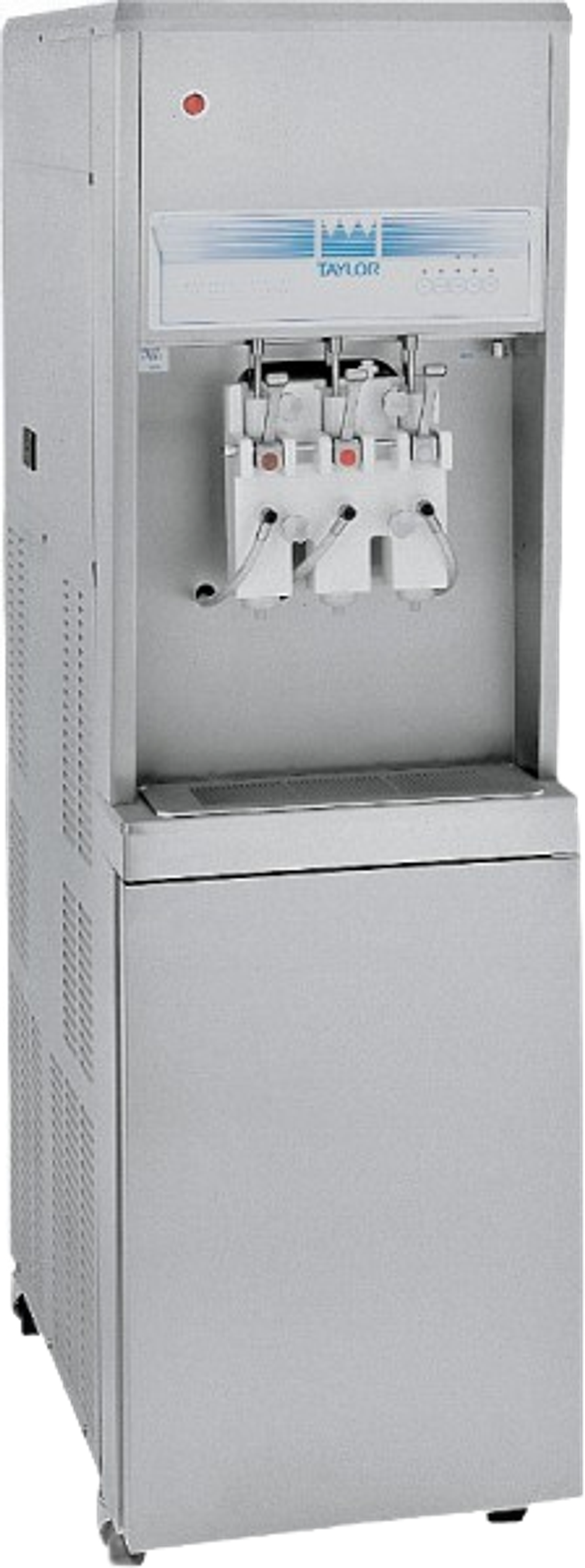
Commercial milkshake machines for convenience stores and gas stations
Convenience stores and fuel sites are the fastest-growing home for shake equipment in Canada, and the buying logic differs from a restaurant's in three ways: the machine is usually self-serve or operated by a single staff member, floor space is measured in centimetres, and the programme runs unattended through long dayparts.
That points most c-store operators toward syrup injection. One hopper, one cleaning routine, and four flavours from a single cabinet fits a site where nobody has an hour at close for equipment teardown. TFI supplies roughly 94 percent of Canadian convenience store chains, including Circle K, so the install patterns for this format are well established.
Operators in this segment usually compare two approaches:
Shake freezer | Blend-in-cup system | |
|---|---|---|
Serve time | Seconds, dispensed on demand | Roughly 60 to 90 seconds per cup |
Product form | Bulk mix poured into a hopper | Pre-filled single-serve cups |
Cost per serving | Lower at volume | Higher per unit, no mix waste |
Cleaning | Daily routine, or extended with heat treatment | Minimal |
Best at | Sustained daily volume | Low or unpredictable volume |
The crossover point is volume. Below roughly 20 servings a day, single-serve packaging usually wins because there is no mix to waste. Above that, the per-serving economics of bulk mix pull ahead and keep pulling ahead. Our guide to convenience store beverage programme ROI works through the same decision across the full cold beverage category, and the commercial slushie machine guide covers the frozen carbonated side of the same counter.
Add-on revenue: what a shake programme adds to a QSR cheque
A shake is an attachment item, so its value shows up in cheque average rather than in traffic. The arithmetic is worth running before you commit.
Take a store handling 300 transactions a day. At an 8 percent shake attach rate, that is 24 shakes a day. At the $4.75 gross profit above, the programme contributes roughly $114 a day, or about $3,400 a month in incremental gross profit, without adding a single customer.
Two levers move attach rate more than menu design does:
Visibility at the point of order. Shakes attach when the customer sees one being poured. A machine in the back of house attaches at a fraction of the rate.
Speed. If a shake adds 90 seconds to the order, staff stop suggesting it during a rush.
Canadian foodservice sales reached $8.8 billion in February 2026, with Ontario alone at $3.43 billion and Nova Scotia posting the largest percentage gain of any province at 2.5 percent. Restaurants Canada has since revised 2026 growth down to 2.3 percent, noting that 56 percent of Canadians have cut back on dining out. In a market growing that slowly, high-margin attachment revenue from existing traffic is worth more than it was two years ago. If you are building the programme from scratch, our guide to adding a frozen dessert programme covers the menu and staffing side.
Razzle blenders: turning shakes into higher-ticket blended desserts
A Razzle machine is a spindle blender that folds mix-ins such as cookies, candy, brownie pieces, nuts, or fruit into soft serve or shake base, producing a thick blended dessert at a higher price point than a plain shake. It is the standard way Canadian operators extend a shake programme without adding a second freezer.
Taylor builds two:
The Razzle Blender BC10 is the countertop unit.
The Razzle Blender BW11 delivers the same blending performance wall-mounted, freeing the counter in tight layouts.
Both run a brushless induction motor for quiet operation and a foot pedal for hands-free blending, draw 2.6 amps on a standard 120V circuit, and take 12 oz and 16 oz Razzle cups with domed lids designed to limit splashing. Optional agitators and mixing collars handle hard mix-ins and hard ice cream.
The commercial case is margin stacking. Mix-ins cost cents and typically support a dollar or more of additional menu price, so the blended item carries a higher absolute gross profit than the shake it is built from. Portion-control mix-in dispenser kits stop that margin leaking. The full line sits under frozen accessories.
Installation requirements: power, clearance, and water
Install requirements block more shake programmes than budget does, and they are worth confirming before you shortlist a model.
Electrical. Taylor shake freezers are manufactured to be permanently connected rather than cord-and-plug, so a dedicated circuit and an electrician are part of the project. Single-cylinder models need one dedicated connection. The 444 needs two.
Air clearance. Air-cooled units need their published clearances respected or performance drops. The 441 and 444 need 76 mm around all sides plus the supplied deflector to stop warm air recirculating. The 62, H60, and 490 need 152 mm on both sides. The 5454 needs 76 mm around the sides and 305 mm above.
Water. Water-cooled configurations use a 3/8" FPT inlet and drain on most models, 1/2" on the 444. Syrup-injection machines such as the 62 also need a 3/8" rinse water line for the flavour-clearing cycle.
Syrup tank placement. On the 62 and 5454, syrup tanks must sit within 1.5 metres of the freezer. Measure that before finalising your counter layout.
Back-of-house space. Budget refrigerated storage for the mix itself. A machine burning through 19 litres of mix a day needs somewhere cold to keep tomorrow's.
Cost, leasing, rentals, and used commercial milkshake machines
TFI quotes per configuration rather than publishing list pricing, because the number depends on model, flavour count, air-cooled or water-cooled build, and install. Our guide to Taylor equipment pricing in Canada sets out the cost drivers in detail. On acquisition, most operators land in one of four places:
Purchase suits established operators with proven shake volume and available capital.
Lease-to-own spreads the cost across the payback window, so the programme's own gross profit services the payment. This is the most common route for operators adding shakes to an existing menu.
Rental fits seasonal sites, patios, event locations, and anyone testing demand before committing.
Certified used equipment lowers the entry cost, particularly for operators testing demand before committing to a new machine.
What to check on a used commercial milkshake machine
A used shake freezer is a refrigeration purchase, so the questions that matter are not cosmetic:
Refrigeration system condition and warranty. The compressor and condenser carry the highest replacement cost in the cabinet. Certified used equipment comes with warranty coverage; uncertified private-sale equipment does not.
Cylinder and beater wear. Scoring in the freezing cylinder and a worn beater assembly show up as texture faults that no cleaning routine fixes.
Whether the machine is heat treatment or non heat treatment. This determines the nightly labour you are inheriting, and it cannot be retrofitted.
Parts availability for the model year. Older Taylor models remain serviceable, but confirm OEM parts supply before you commit.
To compare shake freezers against the wider Taylor frozen range before deciding, our Taylor soft serve machine comparison covers the adjacent categories.
Cleaning, heat treatment, and what causes shake freezer downtime
Dairy is the least forgiving product a foodservice operator handles, and all six models refrigerate mix below 5°C to control it. Health Canada's guidance on safe food storage sets 4°C or lower as the threshold that keeps food out of the danger zone between 4°C and 60°C, and dairy-specific preventive controls are set out in CFIA's dairy guidance. Local public health units and provincial regulations may add requirements, so treat this as operational guidance rather than legal advice.
Heat treatment changes the cleaning economics rather than eliminating cleaning. The system on the H60 pasteurises mix in place on a cycle, which extends the interval between full disassembly cleans. A non heat treatment machine, which is every other model on this list, comes apart on a nightly schedule. That is the single largest labour difference in the range, and it is worth costing in closing-shift minutes rather than in features.
Downtime in this category is rarely dramatic. It is a worn scraper blade producing inconsistent texture, an O-ring that was not seated after a clean, or a condenser choked with dust because the clearance was never respected. All three are preventable.
Aftermarket seals and blades in a dairy machine are the most common cause of repeat texture faults and premature cylinder wear, which is why OEM parts matter here more than brand loyalty would suggest. Genuine Taylor shake components, such as the shake draw valve for the C602 and C606, are stocked in the TFI online shop. A planned maintenance agreement such as TFI Total Care covers scheduled service and parts logistics on one monthly cost, and our soft serve machine maintenance guide covers cleaning cadence for the same class of equipment. When something does fail mid-service, TFI's factory-trained technicians take a service request, OEM components come through parts ordering, and broader repair coverage sits on the commercial kitchen equipment repair page.
Commercial milkshake machine FAQ
What is the best commercial milkshake machine?
For most Canadian operators running a multi-flavour menu at volume, a four-flavour syrup-injection machine is the strongest fit: the Taylor H60 when nightly cleaning labour is the constraint, and the Taylor 62 when it is not. Operators needing two different bases, such as dairy and non-dairy, should specify the Taylor 444 instead, because syrup injection cannot change the base mix.
How much does a commercial milkshake machine cost?
Pricing depends on model, flavour count, air-cooled or water-cooled configuration, install requirements, and whether you buy, lease, or rent, so TFI quotes per configuration rather than publishing list pricing. The more useful planning number is payback: Taylor frozen beverage programmes typically return their cost in 6 to 18 months at 70 to 80 percent gross profit per serving.
How many milkshakes does a commercial machine make per hour?
Sustained output depends on refrigeration recovery rather than tank size. All six Taylor shake freezers freeze in a 6.6 litre cylinder holding roughly 14 servings at 16 oz. The 11,000 BTU/hr models refreeze faster and hold texture through a rush, while the 7,500 BTU/hr Model 490 has about a third less recovery capacity. On refills, an 18.9 litre hopper yields around 40 shakes at 16 oz and the 5454's 57 litre tank yields about 120.
What is an automatic milkshake machine?
An automatic milkshake machine dispenses a finished shake directly from a refrigerated freezing cylinder with no blending step. On syrup-injection models such as the Taylor 62, H60, and 5454, the operator presses a flavour button and raises a draw handle, and the machine blends frozen mix with syrup automatically on the way out. This is what separates a shake freezer from a spindle blender, which mixes each drink individually.
What is a Razzle machine?
A Razzle machine is Taylor's spindle blender for folding mix-ins such as cookies, candy, and fruit into soft serve or shake base to create a thick blended dessert. Taylor makes a countertop model, the BC10, and a wall-mounted model, the BW11, both with a foot pedal for hands-free operation and 12 oz and 16 oz cup formats.
Do I need a heat-treatment shake freezer?
Heat treatment becomes valuable when cleaning labour is a major constraint, because it pasteurises mix in place and extends the interval between full disassembly cleans. A non heat treatment machine comes apart nightly. Evaluate the Taylor H60 against your sanitation schedule and your local public health requirements rather than against its feature list.
Can a commercial milkshake machine make smoothies?
Yes. The Taylor 441, 444, and 490 are specified for shakes, smoothies, frozen coffee, fruit juices, tea slush, and frozen cocktails, held at whatever thickness you set. The constraint is the base: one hopper runs one base at a time, so a machine dedicated to smoothies is not simultaneously making dairy shakes unless it is a two-hopper 444.
Is a used commercial milkshake machine worth buying?
A certified used shake freezer with warranty coverage is a reasonable entry point, particularly for operators testing demand. Check the refrigeration system first, since it carries the highest replacement cost, then the freezing cylinder and beater for wear, and confirm whether the machine is heat treatment or non heat treatment, because that sets your nightly cleaning labour and cannot be retrofitted.
How do I keep dairy safe at the shake station?
Start with temperature discipline and a written cleaning schedule. Health Canada recommends 4°C or lower for refrigerated food, and every Taylor shake freezer holds mix below 5°C through separate hopper refrigeration. Align your standard operating procedures with CFIA preventive control expectations for dairy, and confirm requirements with your local public health unit.
Where can I see a commercial milkshake machine in Ontario?
TFI's Mississauga headquarters and showroom near Toronto Pearson displays equipment for side-by-side comparison, and chef demos let you run your own mix and menu items on the machine before committing. Details are on the Mississauga restaurant equipment page. Atlantic Canada operators can view equipment at the Dartmouth, Nova Scotia showroom.
Ready to spec the right commercial milkshake machine?
The decision comes down to four inputs: your peak-hour shake count, how many flavours the menu needs, whether any of those flavours requires a different base, and how many minutes of closing labour you can give the machine. Answer those four and the model chooses itself from the comparison table above.
TFI has supplied and serviced Canadian foodservice equipment for more than 60 years across Ontario, Nova Scotia, New Brunswick, Prince Edward Island, and Newfoundland and Labrador, with factory-trained technicians backing every install. Send us your volume estimate and floor plan and we will spec the machine and model the return.

Nicole Camposeo-Cheung is the Director of Marketing, People & Culture at TFI Food Equipment Solutions, Canada’s leading provider of premium commercial foodservice equipment. She combines her expertise in business management and fashion arts to foster a dynamic, innovative, and people-centric corporate culture. Passionate about empowering teams, building strong client relationships, and driving growth through creativity and collaboration, Nicole plays a key role in shaping TFI’s brand and workplace culture. She also shares her industry expertise and insights through the TFI blog, helping foodservice professionals stay informed about the latest trends, best practices, and innovations in commercial food equipment.
Add a comment
This will be publicly visible.
Your email address will not be published.
Your comment will be reviewed by an admin before it is published.


