Commercial Cold Beverage Dispensers: A Buyer's Guide for Canadian Operators
A practical buyer's guide to commercial beverage dispensers for Canadian operators: the main types, what they cost, how to size them, and where the strongest margins sit.

A commercial beverage dispenser is one of the simplest ways for a Canadian foodservice operator to add a high-margin, self-serve drink station in 2026. The category runs from refrigerated juice and iced-tea units to insulated portable servers and powered frozen and cold coffee systems, and the right choice depends on your menu, your traffic, and the margin you want to protect. This guide breaks down the main dispenser types, what they cost, how to size a unit, and where the strongest returns sit for convenience stores, cafes, and quick-service restaurants across Ontario and Atlantic Canada.
Planning a self-serve beverage station or a frozen drink programme? Request a free equipment consultation from TFI's team in Ontario or Atlantic Canada.
What Is a Commercial Beverage Dispenser?
A commercial beverage dispenser stores and serves chilled drinks at a controlled temperature, holding product safely while keeping service fast and consistent. Demand is climbing. The global frozen beverage dispenser segment alone reached USD 2 billion in 2025 and is forecast to grow at a 6.6% CAGR through 2034, driven by the expansion of self-serve beverage concepts in convenience and quick service. Convenience stores and quick-service chains are leading that growth as they expand grab-and-go drink menus.
For Canadian operators, the appeal is margin. Cold drinks carry low ingredient costs, and a self-serve station turns a small footprint of counter space into recurring revenue without adding labour. Cold and iced drinks are also where Canadian demand is heading, which makes a permanent cold station a safer bet than a seasonal one. For over 60 years, TFI Food Equipment Solutions has been Canada's largest supplier of specialty foodservice equipment, serving national chains and thousands of independent operators across Ontario, Nova Scotia, New Brunswick, Prince Edward Island, and Newfoundland and Labrador.

A self-serve cold beverage station is one of the few menu additions that lowers labour per drink while protecting margin, which is why convenience and quick-service operators keep expanding the category.
Types of Commercial Beverage Dispensers
Commercial beverage dispensers fall into four main groups, and each fits a different service model and margin profile. Choosing the right type starts with how the drink is held: actively refrigerated, passively insulated, or frozen and churned on demand.
Refrigerated bowl and bubbler dispensers. These hold pre-mixed juice, iced tea, or lemonade in clear spray bowls with built-in refrigeration, usually in one to three bowls. The visible cascade drives impulse purchases, and the unit keeps product within the safe cold range all day.
Insulated and portable dispensers. Unpowered insulated servers hold pre-chilled product for catering, events, and off-site service. They carry no compressor, so they suit mobile setups rather than all-day counter service.
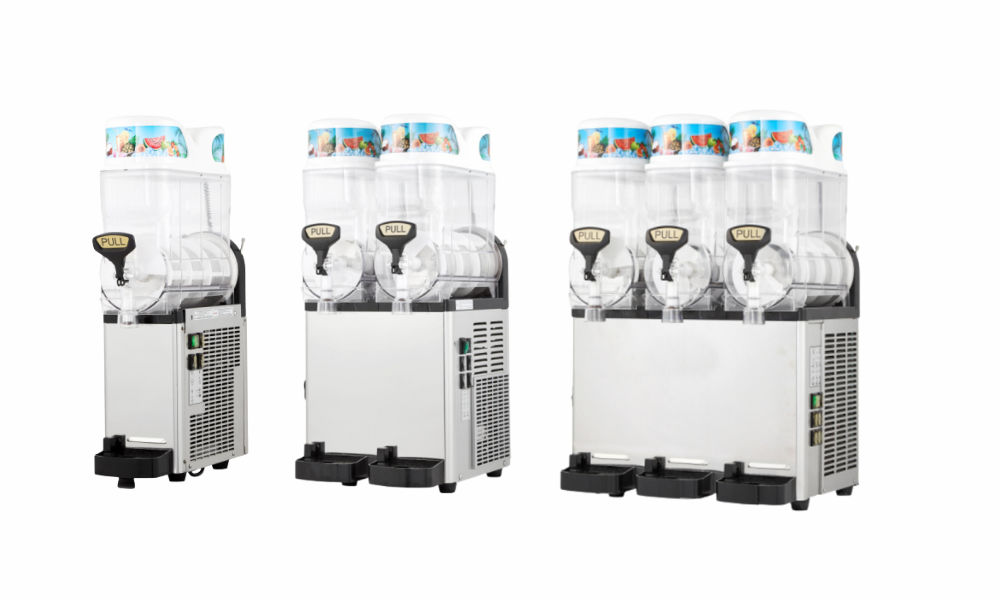
Frozen beverage and slush dispensers. These churn and freeze a syrup-and-water mix into slush across one to three barrels. Self-serve frozen drinks are among the highest-margin beverage categories available to a convenience store programme.
Cold and iced coffee systems. Super-automatic machines dispense iced coffee and cold brew on demand, capturing the year-round shift toward cold and iced coffee covered in our coffee trends guide.
Whichever type you choose, food-safety rules are the same: cold ready-to-eat drinks must be held at 4°C or below to stay out of the bacterial danger zone. Actively refrigerated units handle this automatically; insulated servers rely on the temperature of the product you load and the length of your service window.
How to Choose the Right Commercial Beverage Dispenser
The right commercial beverage dispenser matches your daily volume, your menu, and your available counter space. Work through these factors before you buy:
Capacity and throughput. Estimate peak-hour drink counts, then size bowl or barrel volume to clear that demand without running dry. Undersizing causes line-ups; oversizing wastes product and energy.
Number of flavours. Single-bowl units suit one signature drink; two and three-bowl models let you run juice, tea, and lemonade, or multiple slush flavours, side by side.
Refrigerated versus insulated. For all-day counter service, an actively refrigerated model holds temperature without constant refills. Reserve insulated servers for catering and short-window events.
Footprint and ventilation. Confirm counter depth and the clearance the compressor needs to breathe. Tight, poorly ventilated spaces shorten equipment life.
Cleaning and serviceability. Look for NSF-certified builds with removable bowls, taps, and seals. Daily cleaning is a food-safety requirement, so simple teardown saves labour.
Energy use and certification. Favour ENERGY STAR or NSF-listed units where available. An efficient compressor lowers the running cost of a station that stays powered around the clock, which matters most for units that never switch off.
A quick comparison helps narrow the field:
Dispenser type | Best for | Refrigeration | Margin profile |
|---|---|---|---|
Refrigerated bowl / bubbler | Juice, iced tea, lemonade bars | Built-in, holds 4°C or below | Good, low ingredient cost |
Insulated / portable server | Catering, events, off-site | None, passive | Variable, labour heavy |
Frozen / slush dispenser | C-store and QSR self-serve | Built-in freezing cylinder | Highest, 70-80% gross profit |
Cold / iced coffee system | Cafes, hotels, offices | Built-in chilled delivery | High, 80%+ gross profit |
Profitability and ROI: Where Cold Beverages Pay Off
The strongest returns sit in the powered self-serve categories: frozen and slush drinks, and cold coffee. Both carry low cost per serving, run on minimal labour, and lend themselves to impulse purchase. A single self-serve frozen barrel can turn pennies of syrup and water into a premium-priced cup, and because customers pour their own, the labour cost per drink stays close to zero through busy dayparts. In convenience formats, frozen drinks also pull foot traffic and pair naturally with other high-margin impulse items at the counter.
Frozen and slush programmes built around Taylor and Icetro equipment typically deliver 70-80% gross profit with payback in 6 to 18 months. Self-serve slush fits convenience-store dayparts especially well, and it remains one of the most profitable additions a small-format operator can make. Cold coffee is the other standout: Franke super-automatic systems run hot and iced drinks on one platform, with programmes earning 80%+ gross profit and average paybacks of 6 to 12 months.
Protecting those margins depends on uptime and compliance. Every cold dispenser has to hold product out of the danger zone between 4°C and 60°C, and a unit that drifts warm means dumped product and lost sales. Pairing the right dispenser with a planned-maintenance and repair partner keeps the station earning.
Frozen and cold coffee programmes are among the highest-margin beverage categories in Canadian foodservice, with frozen drinks reaching 70-80% gross profit and cold coffee clearing 80%.

Why Taylor, Icetro, and Franke Equipment Is a Smart Investment
For powered cold beverage stations, equipment reliability is the difference between a station that prints margin and one that sits down for repairs. TFI supplies and services the brands built for continuous Canadian foodservice use.
Taylor and Icetro slush machines cover single and multi-barrel frozen beverage service, and Icetro's lineup is engineered for technician-friendly serviceability that keeps maintenance simple. For cold and iced coffee, Franke super-automatic systems, including the Franke A Series, deliver consistent cup quality across hot and cold drinks with minimal staff training.
Just as important, operators get the equipment and the service from one partner. TFI's factory-trained, annually certified technicians handle cold-side repairs on frozen beverage systems, slush machines, and coffee equipment, with 24/7 emergency support that protects uptime and revenue. Operators can also fold equipment into a TFI Total Care planned-maintenance plan, which schedules preventive service so a cold station is less likely to fail during a summer rush.

Buying a Commercial Beverage Dispenser in Canada
TFI sells, installs, and services cold beverage equipment across its five service provinces, with a showroom in Mississauga, Ontario and an Atlantic location in Dartmouth, Nova Scotia. Operators in the GTA and across Ontario can book demos at the Mississauga showroom, while operators in Halifax, Moncton, Charlottetown, and St. John's are served from the Dartmouth location.
Beyond new equipment, TFI offers equipment rentals and lease-to-own financing to spread the cost of a new station, plus certified used equipment with warranty for operators testing a category before committing. Every install includes setup and staff training so a new dispenser is running and your team is confident before the first service. Free consultations and ROI modelling help match the dispenser to your expected volume and margin targets.
Cheat Sheet: Match Your Use Case to the Right Dispenser
Use case | What to look for | TFI equipment or programme |
|---|---|---|
C-store self-serve frozen drinks | Multi-barrel, high throughput, simple cleaning | Taylor and Icetro slush machines, 70-80% gross profit |
Cafe cold and iced coffee | One platform for hot and cold, low training | Franke super-automatic systems, 80%+ gross profit |
QSR beverage station | Reliable refrigeration, fast service, OEM support | Frozen and cold coffee equipment plus 24/7 service |
Catering and events | Portable, insulated, no power needed | Insulated servers, pre-chilled product |
New operator testing a category | Lower upfront cost, warranty |
Frequently Asked Questions
What is a commercial beverage dispenser?
A commercial beverage dispenser is a foodservice unit that stores and serves chilled drinks, such as juice, iced tea, lemonade, slush, or cold coffee, at a controlled temperature for fast self-serve or counter service. Powered models use built-in refrigeration to hold product at 4°C or below, while insulated servers hold pre-chilled product without power for events and catering.
How does a commercial cold beverage dispenser work?
A refrigerated beverage dispenser circulates and chills product using a built-in cooling system, often with an agitator or spray mechanism that keeps the drink mixed and visible. Frozen and slush dispensers go further, churning a syrup-and-water mix against a frozen cylinder to produce a consistent semi-frozen texture on demand.
What temperature should a commercial beverage dispenser hold?
Cold ready-to-eat drinks should be held at 4°C or below to stay out of the bacterial danger zone of 4°C to 60°C. Actively refrigerated dispensers maintain this automatically, which is why they are the standard for all-day service rather than unpowered insulated servers.
How much does a commercial beverage dispenser cost?
Pricing varies widely by type and capacity, from entry-level countertop units to multi-barrel frozen systems and super-automatic coffee platforms. Because margin and payback matter more than sticker price, the better question is return: frozen programmes commonly reach 70-80% gross profit. Contact TFI for a quote and an ROI estimate based on your expected volume.
What is the best commercial beverage dispenser for a convenience store?
For convenience stores, a multi-barrel frozen or slush dispenser is usually the strongest fit because self-serve frozen drinks carry high margins and suit impulse purchase across the day. A c-store slush programme pairs well with the dayparts and footprints that most Canadian convenience formats run. Cafes and offices leaning into cold coffee are better served by a super-automatic system.
Can you rent a commercial beverage dispenser in Canada?
Yes. TFI offers equipment rentals and lease-to-own financing across Ontario and Atlantic Canada, which lets operators launch a beverage station with lower upfront cost. Certified used equipment with warranty is also available for operators testing a category before buying new.
Conclusion
Whether you are adding a self-serve slush bar with Taylor and Icetro equipment or a cold coffee station built on Franke super-automatic systems, our team can size the right dispenser and model the payback before you commit. Reach out to our experts and request a free quote today!

Nicole Camposeo-Cheung is the Director of Marketing, People & Culture at TFI Food Equipment Solutions, Canada’s leading provider of premium commercial foodservice equipment. She combines her expertise in business management and fashion arts to foster a dynamic, innovative, and people-centric corporate culture. Passionate about empowering teams, building strong client relationships, and driving growth through creativity and collaboration, Nicole plays a key role in shaping TFI’s brand and workplace culture. She also shares her industry expertise and insights through the TFI blog, helping foodservice professionals stay informed about the latest trends, best practices, and innovations in commercial food equipment.
Add a comment
This will be publicly visible.
Your email address will not be published.
Your comment will be reviewed by an admin before it is published.


