What Is a Commercial Restaurant Equipment Service Plan? (A Canadian Operator's Guide)
Not all restaurant equipment service contracts are created equal. This guide breaks down what a solid commercial restaurant service plan actually includes, how to evaluate your options, and what Canadian operators should demand before signing anything.

A commercial restaurant equipment service plan is a structured agreement between a foodservice operator and a certified service provider that covers scheduled preventive maintenance visits, emergency repair calls, parts logistics, and staff training, all bundled into a predictable monthly cost.
Rather than reacting to equipment failures as they happen, a service plan shifts your operation to a proactive model, reducing downtime, extending equipment life, and eliminating the financial shock of unplanned repairs.
If you run a quick service restaurant, franchise location, or high-volume kitchen in Canada, understanding what a service plan includes, and how to evaluate your options, is one of the more consequential operational decisions you can make.
Why a Service Plan Matters for Canadian Operators
Commercial restaurant equipment does not fail on a schedule. A soft serve machine going down on a Friday night, a fryer throwing an error code at lunch rush, a coffee system stalling mid-service: these are not hypotheticals. They are common, and without a plan in place, your response options are slow, expensive, and uncertain.
The traditional break-fix model puts you in a reactive position every time. You call, you wait, you pay overtime rates, you source your own parts, and you absorb the revenue hit while the equipment sits idle. A service plan like TFI total care eliminates most of that friction before it starts.
Beyond downtime, there is a cost predictability argument. When equipment repair is a variable and unpredictable line item, it is genuinely difficult to budget around. A flat monthly rate changes that.

What a Commercial Restaurant Service Plan Typically Includes
Service plans vary by provider, but a well-structured plan should cover all of the following categories. If a provider cannot clearly articulate what is and is not included in each, that is a signal worth noting.
Planned Maintenance Visits
Preventive maintenance is the foundation of any real service plan. Scheduled technician visits, completed on a set cadence, allow problems to be identified and corrected before they cause a failure. Technicians inspect components, clean critical systems, test calibration, and flag wear parts approaching end of life. This is what separates a service plan from an extended warranty, which only activates after something breaks.
Reactive Service Calls
When equipment does fail, a service plan should give you priority access to technicians without the overhead of sourcing service on an ad hoc basis. Look for plans that include emergency or same-day response coverage, and confirm whether reactive calls are treated as included or billed separately.
Parts Logistics and Mailers
Parts availability is where many third-party repair situations fall apart. A provider with deep manufacturer relationships and stocked parts inventory can often resolve a repair in a single visit. Plans that include parts mailers or covered shipping for components are particularly valuable for operators running specialized equipment with proprietary parts.
Technical Support
Not every issue requires a technician on site. Access to expert technical support, by phone or otherwise, allows operators to resolve minor errors, understand diagnostic codes, and determine whether something requires immediate service or can wait for a scheduled visit. This reduces unnecessary service calls and the cost associated with them.
Staff Training
Operator error is a significant and underreported driver of commercial equipment issues. Staff who do not understand proper cleaning procedures, loading protocols, or basic diagnostics create avoidable wear. A plan that includes hands-on staff training addresses this at the source, and the compounding effect over a year or two is meaningful.
Predictable Monthly Pricing, No Overtime Charges
This is a structural point worth evaluating carefully. Plans that expose you to overtime rates, after-hours call premiums, or parts markups on top of a base rate are not true all-in agreements. Flat monthly pricing with no overtime charges is the cleaner model for budgeting and for trust.

How to Evaluate a Commercial Restaurant Service Contract
Not all plans are equal. Here is what to look at when comparing options.
Technician certification and brand specialization. Equipment like Taylor soft serve machines, Henny Penny fryers, Franke coffee systems, and equipment under the Middleby banner are complex, proprietary, and often require factory-trained technicians to service correctly. A general appliance technician working from a manual is not the same as someone who has completed factory certification for that specific equipment line. Ask who trains the technicians and how frequently those certifications are renewed.
Geographic coverage and response time. A national or regional service provider with technicians distributed across your operating geography is materially different from a provider who services your area with one or two techs. Response time commitments should be explicit, not implied.
Scope clarity. What is covered, what is excluded, and who makes the call on parts replacement? Vague plan language creates disputes at the worst possible time, which is when equipment is down.
Tenure and track record. The depth of institutional knowledge at a service provider scales with years in the industry. A team that has serviced a specific equipment brand for decades will diagnose and resolve issues faster than one that is still building that history.
Consolidation of coverage. If you run multiple equipment brands across a location or multiple locations, a provider who can cover all of it under a single plan reduces vendor management complexity considerably.
What Makes TFI Total Care Different
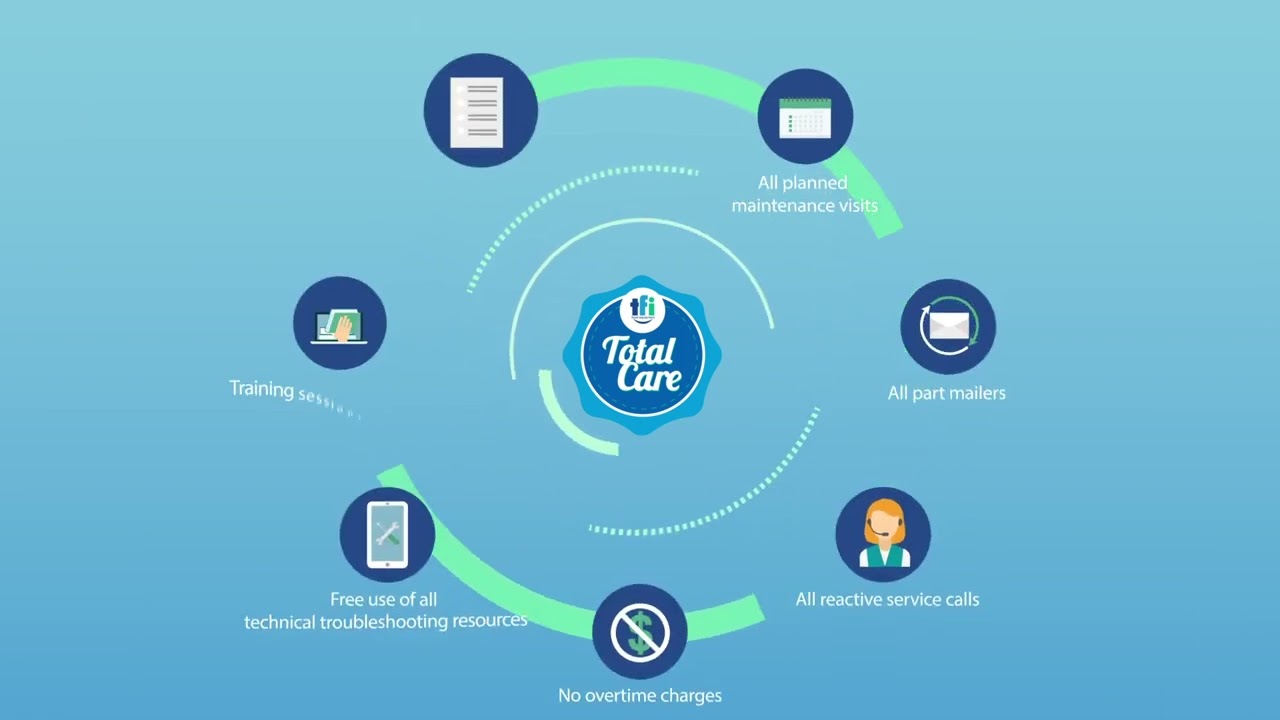
TFI Total Care is TFI Canada's all-in-one service plan for commercial foodservice operators, designed to cover your equipment for a flat monthly rate.
TFI has been in the Canadian foodservice equipment industry for over 60 years. That matters here not as a marketing statement but as a practical one: the institutional knowledge, parts inventory, and manufacturer relationships that come with six decades in a specialized industry are not replicable quickly.
The TFI team includes over 100 service professionals with an average tenure approaching 10 years. Factory-trained certifications for Taylor, Henny Penny, and Franke, renewed annually, mean the technicians working on your equipment are current on the specific systems they are servicing.
TFI Total Care includes all six components outlined above: planned maintenance visits, reactive service calls, parts mailers, technical support, staff training, and flat monthly pricing with no overtime charges. For operators running Taylor soft serve systems, Henny Penny pressure or open fryers, Lightfry air fryers, or Franke bean-to-cup coffee equipment, or any equipment under the Middleby banner, it is the most purpose-built plan available in Canada.
Service coverage spans Ontario, Nova Scotia, New Brunswick, Prince Edward Island, and Newfoundland.
If your equipment is due for a service visit or you are mid-repair situation right now, you can also submit a service request directly or review TFI's broader commercial kitchen equipment repair services.
Questions to Ask Before Signing Any Service Plan
Before committing to a planned maintenance program, ask any provider these directly:
Are your technicians factory-certified for the specific brands I operate?
How are reactive calls handled, and are they included in the monthly rate?
What is your average response time in my region?
Are parts covered, and how are mailers or shipping handled?
Does the plan include staff training, and how is that delivered?
Are overtime or after-hours rates ever applied on top of the plan fee?
If the answers are clear and documented in the contract, you are in a good position. If they are vague or deferred to "case by case," treat that as a flag.
The Bottom Line
A commercial restaurant service plan is not a luxury line item for large chains. For any operator running specialized foodservice equipment, it is the lowest-cost way to manage risk, protect revenue, and extend the life of assets that are expensive to replace.
The plan you choose matters as much as having one. Factory-trained technicians, genuine parts, real preventive maintenance, and flat pricing are the criteria that separate a useful plan from one that looks good until something breaks.

Nicole Camposeo-Cheung is the Director of Marketing, People & Culture at TFI Food Equipment Solutions, Canada’s leading provider of premium commercial foodservice equipment. She combines her expertise in business management and fashion arts to foster a dynamic, innovative, and people-centric corporate culture. Passionate about empowering teams, building strong client relationships, and driving growth through creativity and collaboration, Nicole plays a key role in shaping TFI’s brand and workplace culture. She also shares her industry expertise and insights through the TFI blog, helping foodservice professionals stay informed about the latest trends, best practices, and innovations in commercial food equipment.
Add a comment
This will be publicly visible.
Your email address will not be published.
Your comment will be reviewed by an admin before it is published.


