
Soft Serve Machine Repair: Ice Cream Machine Troubleshooting Guide
Soft serve machine not working? This guide covers common ice cream machine repair issues, what your staff can troubleshoot safely, and when it is time to call a certified technician.

A soft serve machine that stops freezing, leaks from the door, or locks into a clean cycle can shut down one of your most profitable menu categories within minutes. For restaurants, convenience stores, cafes, and dessert operators across Canada, the critical question is not just how to fix a soft serve machine, but which problems are safe for your team to handle and which ones require a certified technician. Soft serve programmes typically deliver 70-80% gross profit with payback in 6 to 18 months, so every hour of unplanned downtime cuts directly into revenue.
If your soft serve machine needs immediate expert attention, submit a service request to TFI Food Equipment Solutions for 24/7 certified repair support across Ontario and Atlantic Canada.
Important: This article provides general troubleshooting guidance and is not a substitute for your machine's operator manual. Always refer to your specific model's manual before performing any maintenance or troubleshooting. If you are unsure about any step, submit a service request to speak with a TFI certified technician.
Soft Serve Machine Troubleshooting: Symptoms, Causes, and What to Check
The first step in any soft serve machine repair situation is identifying the symptom and determining whether the issue is operator-correctable or technician-required. The table below covers the most common soft serve machine problems, their likely causes, safe operator checks, and whether to attempt a fix or call for service. These checks are based on common operator-side procedures documented across Taylor soft serve manuals, including Mix Low and Mix Out alerts, brush-clean lockouts, door assembly wear points, and airflow requirements. Always follow the exact procedure for your specific model.
Symptom | Likely Cause | Safe Operator Checks | DIY or Call a Technician? |
|---|---|---|---|
Machine is not freezing properly or product is too soft | Low mix, blocked airflow, incorrect reassembly, mode or settings issue, or a deeper refrigeration problem | Confirm mix level, verify operating mode, check air intake and discharge are clear, verify assembly and priming after cleaning | DIY first. If product still will not harden after these checks, call for service. |
Mix Low, Mix Out, or inconsistent product | Low hopper level, feed issue, priming problem, wrong mix, or component wear | Refill with approved mix, confirm feed components are seated correctly, review last cleaning and priming steps | DIY first. If alerts continue with a full hopper, call for service. |
Leaking from the front door or draw area | Worn gasket, damaged O-rings, cracked door parts, or assembly error | During cleaning, inspect door gasket, draw valve, O-rings, and door surfaces for nicks, cracks, or wear, then reassemble exactly per the manual | DIY inspection only. If parts are worn or leaking continues, call for service. |
Beater stops or motor overload trips | Product freezing too hard, excessive resistance, or an electrical or motor fault | Check for obvious product freeze-up and follow the model's operator reset procedure only if trained | Call for service if the overload repeats. |
Machine stuck in clean cycle or brush-clean lockout | Required cleaning cycle not completed, heat-treatment cycle incomplete, or a control issue | Complete the required brush-clean or heat-treatment procedure exactly as your model manual states | DIY once. If the lockout remains after one correct attempt, call for service. |
Machine runs but output is slow, uneven, or poor quality | Wear parts, assembly issue, inconsistent mix supply, or early mechanical failure | Check mix level, confirm assembly, inspect visible seals, and note any alarms or unusual sounds | DIY first. If quality does not return quickly, call for service. |
Most soft serve machine problems start with one of three operator-side issues: low mix, incorrect reassembly after cleaning, or blocked airflow. Checking these first can save an unnecessary service call.
What Operators Can Usually Fix
Not every soft serve machine problem requires a technician. The issues below are the most common operator-correctable problems, and addressing them quickly can prevent unnecessary downtime and service costs.
Low Mix and Basic Feed Problems
Many "soft serve machine not working" calls start with the simplest issue: the unit is low on mix or the feed system was not set correctly after cleaning. On many Taylor models, the machine warns the operator when mix is low, and some units shut down automatically when mix is nearly exhausted to protect internal components. Your first check should always be product level, approved mix, and proper priming.
What staff can do safely:
Refill with the correct, approved mix
Confirm the machine is in the correct operating mode
Recheck assembly and priming steps from the model-specific manual
Record any on-screen message or alarm code before restarting
What staff should not do:
Change recipe ratios without verifying the correct specifications
Keep restarting the machine without understanding the alarm
Open service panels or bypass controls
For a deeper look at how these machines process mix into finished product, see TFI's guide on how soft serve machines work.
Airflow Problems on Air-Cooled Machines
A soft serve machine that is not freezing properly is not always a compressor failure. Taylor manuals warn that blocked air intake and discharge can reduce refrigeration capacity and damage internal components over time. If the machine cannot pull heat away from the product effectively, it cannot freeze properly.
Safe checks for staff:
Confirm that boxes, walls, or other equipment are not crowding the unit
Clean the surrounding area so vents stay open
Follow the model's instructions for any user-serviceable condenser filter or airflow maintenance
If the machine still produces soft product after airflow is corrected, the issue moves from the "operator error" category into the "technician required" category.
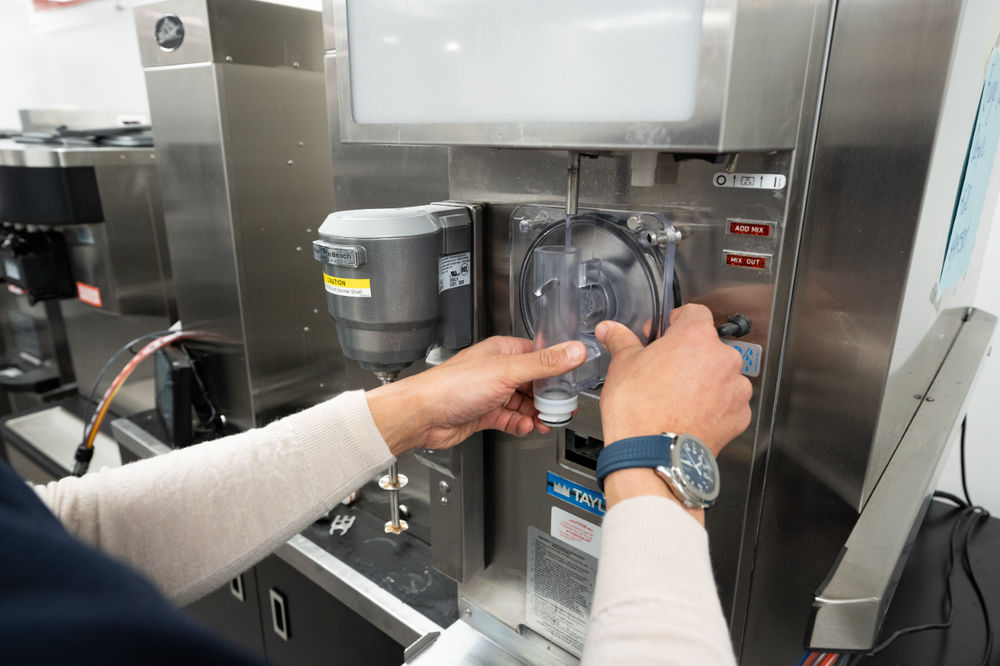
Door Seal Leaks and Front-End Drips
If mix is leaking from the front door, around the draw valve, or down the face of the machine, the cause is often wear in door gaskets, O-rings, or related front-end parts. Taylor manuals instruct operators to inspect the door bearing, gasket, draw valve, and O-rings for nicks, cracks, or wear before reassembly.
In practice:
A small leak after cleaning may be an assembly error that is correctable on the spot
A recurring leak is likely a wear-parts problem that needs replacement
If a gasket or O-ring looks damaged, the correct move is replacement, not forcing the unit to keep running
Your team can inspect and reassemble, lubricating O-rings with food-grade Taylor Lube HP as the manual specifies. A certified technician should handle repeated leaks, damaged components, or any leak that appears to be coming from inside the cabinet rather than the removable front assembly.
Preventive Cleaning and Maintenance
Many of the issues above start as minor maintenance gaps that compound over time. Operators who follow a consistent cleaning and inspection schedule experience fewer emergency repair calls. For a complete daily, weekly, and periodic maintenance schedule, review TFI's soft serve machine maintenance guide. Keep the right brushes on hand too: TFI stocks the Taylor non-heat treatment brush kit and heat treatment brush kit for soft serve machines.
Problems That Require a Certified Technician
The issues below go beyond what operators should attempt. Repeated DIY efforts on these problems risk product waste, extended downtime, and more expensive damage.
Repeated Motor Overloads
A motor overload is not something you fix by hitting reset repeatedly. While some Taylor models include operator-accessible reset controls, repeated overloads signal excessive resistance, a product freeze-up, or a deeper electrical or mechanical fault.
Call a certified technician when:
The overload trips more than once in the same operating period
The machine restarts and fails again within minutes
You hear grinding, straining, or unusual motor noise
The barrel freezes too hard or product flow becomes erratic
Calling early is almost always cheaper than stretching the problem until a minor issue becomes a major parts failure.
Clean Cycle or Brush-Clean Lockouts
Modern soft serve machines are designed to protect product safety through mandatory cleaning cycles. Taylor documentation confirms that certain models lock automatic operation until the required brush-clean procedure or heat-treatment cycle has been completed correctly.
If your machine is stuck in this state:
Stop guessing and pull the exact model manual
Run the required cleaning or heat-treatment process exactly as specified
If the lockout remains after one correct attempt, call for service
One correct attempt is reasonable. Repeated trial-and-error is not, and risks triggering additional safety lockouts.
Persistent Freezing and Consistency Problems
If the machine has enough mix, proper airflow, correct assembly, and the right mode selected, but still will not freeze or deliver consistent product, you are likely past the DIY stage. At that point, the fault may involve refrigeration components, sensors, controls, or internal mechanical wear that requires diagnostic tools and training to identify.
When a soft serve machine will not freeze despite correct mix levels, clear airflow, and proper assembly, the issue is almost always internal: refrigeration, sensors, or controls that require a certified technician with diagnostic tools.

A Simple Rule for Deciding DIY vs. Service
Use this filter to decide whether your team should troubleshoot or pick up the phone:
Safe for Operator Checks | Call a Certified Technician |
|---|---|
Low mix or empty hopper | Repeated motor overload or reset requirement |
Visible front-end gasket wear during routine cleaning | Internal electrical or refrigeration issue |
Incorrect mode selection | Clean-cycle or lockout that does not clear after one correct attempt |
Obstructed airflow around the unit | Persistent leaks after reassembly |
Rechecking assembly after cleaning | Product quality problems that return quickly after operator checks |
Taylor manuals consistently separate operator procedures from authorised service work. TFI's repair programme mirrors this distinction: factory-trained technicians, annually renewed certifications, and genuine OEM parts on every call.
Why Certified Service Matters for Soft Serve Equipment
Soft serve machines are high-value assets that protect a high-margin menu category. Canadian limited-service eating places generated over $47 billion in sales in 2025 according to Statistics Canada, and frozen desserts are a significant contributor to that revenue. According to Restaurants Canada, unplanned equipment downtime is one of the top operational cost drivers for foodservice operators. The cost goes beyond the repair bill: lost product, lost sales during peak hours, and potential food safety concerns all add up quickly.
TFI Food Equipment Solutions provides commercial kitchen equipment repair services for soft serve machines and other hot-side, cold-side, and beverage equipment across Ontario and Atlantic Canada. Over 100 experienced service professionals, each averaging nearly 10 years of tenure, deliver certified repair using genuine OEM parts. Technicians are factory-trained and maintain factory-certified badges renewed annually.
For operators who want fewer emergency calls and more predictable uptime, TFI Total Care bundles reactive service calls, planned maintenance visits, parts supply, troubleshooting support, year-round training, and no overtime charges into one monthly service solution. Contact TFI to learn more about Total Care or to schedule a consultation.
Regional Service Coverage: Ontario and Atlantic Canada
TFI's service team supports operators across Ontario, including the Greater Toronto Area, Mississauga, Hamilton, Ottawa, and surrounding regions. Atlantic Canada coverage includes Nova Scotia (Halifax, Dartmouth), New Brunswick (Moncton, Saint John, Fredericton), Prince Edward Island (Charlottetown), and Newfoundland and Labrador (St. John's).
Whether you operate a single cafe in Dartmouth or a multi-location chain across Ontario, TFI's technicians can reach your site for both scheduled maintenance and emergency repair requests.
When Repair Becomes Replacement
If your team is calling for service repeatedly, losing product to inconsistent quality, or dealing with chronic downtime during peak periods, the smarter move may be reviewing your current equipment against newer commercial soft serve machines. TFI supplies Taylor countertop and freestanding models in Canada, and Icetro soft serve models. These include lines built for different volumes, footprints, and menu formats.
Soft serve remains one of the most profitable menu additions for Canadian foodservice operators, with programmes delivering 70-80% gross profit and payback in 6 to 18 months. Upgrading to a newer, more reliable unit can reduce service costs, improve product consistency, and protect your revenue during high-traffic periods.
FAQs
What are common problems with soft serve machines?
The most common soft serve machine problems include mix not freezing properly, low mix or Mix Out alerts, leaking from the front door or draw area, motor overload trips, clean-cycle lockouts, and slow or inconsistent product output. Many of these start with operator-side issues like low mix, incorrect reassembly after cleaning, or blocked airflow. Persistent problems involving refrigeration, electrical faults, or repeated overloads should be handled by a certified technician. TFI provides 24/7 emergency repair for operators across Ontario and Atlantic Canada.
How do you fix a soft serve machine that is not freezing?
Start by checking the mix level, verifying the machine is in the correct operating mode, and confirming that air intake and discharge vents are not blocked. Then verify the unit was assembled and primed correctly after the last cleaning. If the machine still will not freeze after these checks, the issue likely involves refrigeration components, sensors, or controls that require a certified technician with diagnostic tools.
Why is my soft serve machine not dispensing?
A soft serve machine that will not dispense has usually been incorrectly reassembled after cleaning or has a buildup that needs to be removed. Disassemble the front end, clean all components, and reassemble exactly as instructed in your model manual. If the issue persists, the cause may be a frozen barrel, a worn beater, or a mechanical fault that requires professional service.
How do you reset a soft serve machine?
The reset procedure varies by model. Most Taylor soft serve machines have an operator-accessible reset control, but you should only use it if your staff have been trained on the specific procedure for your unit. Check your model's specs and manual page for the exact steps. If the machine requires reset more than once in the same operating period, stop resetting and call for service, as repeated resets indicate a deeper problem.
How often should a soft serve machine be cleaned to prevent breakdowns?
Most commercial soft serve machines require daily exterior cleaning, regular brush-cleaning cycles (frequency varies by model), and periodic deep cleaning of all removable parts. Skipping or shortcutting these cycles is the leading cause of preventable breakdowns, including lockouts, inconsistent product, and premature wear on seals and gaskets. Follow your model's exact cleaning schedule, and review TFI's soft serve machine maintenance guide for a complete breakdown of daily, weekly, and periodic tasks.
When should you call a technician instead of troubleshooting yourself?
Call a certified technician when you encounter repeated motor overloads, a clean-cycle lockout that does not clear after one correct attempt, persistent leaks after reassembly, ongoing freezing or consistency problems despite correct mix and airflow, or any electrical or refrigeration symptom. Taylor manuals consistently separate operator procedures from authorised service work, and attempting repairs beyond the operator level risks voiding warranty coverage, damaging components, and creating food safety issues.
Take the Next Step
TFI Food Equipment Solutions supports Ontario, Nova Scotia, New Brunswick, Prince Edward Island, and Newfoundland and Labrador with sales, installation, training, rentals, leasing, and 24/7 OEM-quality service. Whether you need a one-time repair, a planned maintenance programme, or a full equipment upgrade, TFI's factory-trained technicians and genuine OEM parts keep your soft serve operation running.
If you have any questions or need helping servicing your soft serve machine, request a quote from TFI today!
Machine still not freezing? If these fixes haven't solved it, request urgent service and a factory-trained TFI technician will be in touch. For a less urgent issue, book a service call, or order genuine Taylor parts online and fix it yourself.

Nicole Camposeo-Cheung is the Director of Marketing, People & Culture at TFI Food Equipment Solutions, Canada’s leading provider of premium commercial foodservice equipment. She combines her expertise in business management and fashion arts to foster a dynamic, innovative, and people-centric corporate culture. Passionate about empowering teams, building strong client relationships, and driving growth through creativity and collaboration, Nicole plays a key role in shaping TFI’s brand and workplace culture. She also shares her industry expertise and insights through the TFI blog, helping foodservice professionals stay informed about the latest trends, best practices, and innovations in commercial food equipment.
Add a comment
This will be publicly visible.
Your email address will not be published.
Your comment will be reviewed by an admin before it is published.


