
Restaurant Equipment Maintenance in Canada: The True Cost of Equipment Breakdowns
A single equipment failure can cost a Canadian restaurant hundreds of dollars per hour in lost sales, wasted labour, food spoilage, and emergency service fees. This guide breaks down the real cost of downtime and explains why planned maintenance is often the smarter financial decision.

The True Cost of Commercial Kitchen Equipment Breakdowns for Canadian Restaurants
A commercial fryer breakdown during a busy service window can cost a Canadian restaurant roughly $400 to $800 in lost sales per hour on a conservative estimate. That figure is derived from 2024 Canadian industry averages for restaurant revenue, then adjusted for the reality that dinner rush and lunch peaks often run well above an all-day average hour. Stretch that outage across a three-hour rush and the hit can quickly climb past $1,500 to $3,000 once you factor in wasted labour, food loss, discounts, refunds, and emergency repair costs. Canadian operators also work on thin margins: the average net profit for full-service and limited-service restaurants was only 2.5% in the latest federal industry data.
That is the real problem with restaurant equipment maintenance. The repair invoice is only one line item. The bigger cost is everything that happens while the equipment is down. In Ontario alone, foodservice sales reached $3.37 billion in May 2025, while Nova Scotia recorded $201.3 million, New Brunswick $146.4 million, Prince Edward Island $38.0 million, and Newfoundland and Labrador $95.0 million. In a market this active, downtime is not a nuisance. It is a revenue leak.
Looking to protect uptime on your most critical kitchen equipment? Request a service consultation from TFI's team in Ontario or Atlantic Canada.
Why equipment breakdowns cost more than the repair itself
When a core piece of equipment fails, you lose more than production capacity. You lose throughput, staff efficiency, menu availability, and often customer trust. A fryer outage can bottleneck an entire hot line. A soft serve failure can wipe out one of your highest-margin impulse categories. A coffee machine problem can slow breakfast service and reduce ticket lift. Downtime hurts operations, and planned maintenance exists to prevent those costly surprises.
There is also a margin issue. According to Innovation, Science and Economic Development Canada, the average Canadian restaurant in this category generated $849,200 in annual revenue in 2024, but only 2.5% net profit. That means even a modest sales disruption can erase a disproportionate amount of bottom-line income. In the same dataset, average repairs and maintenance spending was $15,800 per year, or about $1,300 per month. One bad Friday-night breakdown can therefore eat up the equivalent of one to two months of a typical operator's annual maintenance budget.
Canadian restaurants average just 2.5% net profit on $849,200 in revenue. One three-hour equipment failure during a dinner rush can erase the equivalent of one to two months of a typical operator's entire annual maintenance budget.
The hidden costs that hit after a machine goes down
1. Lost sales during peak periods
The first hit is obvious: you cannot sell what you cannot produce. If your fryer, grill, combi oven, slush machine, or coffee system is central to your menu, throughput drops immediately. TFI's repair team specifically supports hot-side, cold-side, and beverage equipment because those failures directly affect service speed and uptime.
2. Labour still costs money even when output drops
Your team is still on the clock, but the line slows down, staff begin workarounds, and managers get pulled into troubleshooting instead of service. With margins this thin, downtime converts payroll from productive labour into overhead very quickly. The federal data shows labour-related expense lines consume a major share of revenue in Canadian restaurants, which is exactly why equipment reliability matters operationally, not just mechanically.
3. Food waste and food safety risk
Cold-side failures are especially expensive because they can become inventory losses, not just sales losses. Health Canada advises keeping refrigerators at 4°C or lower and freezers at -18°C or lower, specifically to keep food out of the temperature danger zone where bacteria can grow quickly. If a cooler or frozen dessert unit drifts outside safe holding conditions, you may end up discarding product and compounding the cost of the breakdown.
4. Emergency service usually costs more
Reactive repair is almost always more expensive than organized planned maintenance because you are paying for urgency, dispatch, technician time, and parts while the business is under pressure. Thats why we offer TFI Total Care - no overtime charges as a core benefit of the programme. That only matters because after-hours service is normally the kind of event operators want to avoid.
5. Customer loss is hard to recover
When a guest cannot order a signature item, gets delayed at the counter, or receives an inconsistent product because the team is improvising, the immediate lost sale is not the only cost. You also risk losing the repeat visit. This matters most on high-frequency categories like coffee, fried menu items, desserts, and frozen beverages, where consistency drives habit.
Three breakdown scenarios that show the real ROI of planned maintenance
Scenario 1: The fryer goes down on a Friday night
For many Canadian restaurants, the fryer is not just another appliance. It is a throughput engine. If it fails during peak service, orders back up, ticket times increase, side items disappear, and delivery performance can collapse. On a conservative model based on Canadian average industry revenue, a busy service hour can represent $400 to $800 in lost sales. Over a three-hour dinner rush, that becomes $1,200 to $2,400 in lost sales before you account for staff inefficiency, refunds, or emergency repair charges.
If that fryer is a modern low-oil unit, the downtime can hurt twice. Commercial fryers with built-in oil management systems can use 40% less oil and extend oil life significantly compared to conventional models. When that platform is down, you are not only losing fried-food sales. You are interrupting a cost-saving system designed to improve margin every day it runs.
Scenario 2: The soft serve machine fails in summer
Dessert and frozen treats often look like a side category until the machine stops working. A properly built soft serve programme can generate 70% to 80% gross profit per serving and achieve payback in 6 to 18 months. That means a summer outage does not just remove revenue. It removes some of the most profitable revenue on the menu. For operators relying on seasonal traffic, weather-driven demand, or family add-on purchases, that is a painful category to lose.
A well-structured soft serve programme typically delivers 70-80% gross profit with payback in 6-18 months. Losing that category during a summer peak does not just cut revenue; it cuts some of the most profitable revenue on the menu.
Scenario 3: The coffee machine goes down during breakfast or morning rush
Coffee is another category where downtime is more expensive than it looks. A super-automatic coffee programme is capable of 80% gross profit potential with typical payback in 6 to 12 months. If a breakfast restaurant, café, QSR, or convenience-led operation loses that programme during peak morning traffic, the business loses a high-margin product and often a basket-builder that lifts pastry, breakfast sandwich, and combo sales at the same time.
Why planned maintenance in a commercial kitchen is an ROI decision
This is why planned maintenance for commercial kitchen equipment should be treated as a financial strategy, not a line-item expense. Preventive servicing reduces surprise failures, keeps equipment calibrated, protects food quality, and spreads service activity across a predictable schedule. TFI Total Care is built around exactly this logic: reactive service calls, planned maintenance visits, parts logistics, troubleshooting support, training, and no overtime charges, all structured to reduce downtime volatility.
The manufacturer perspective supports the same approach. Taylor notes that prioritising commercial equipment maintenance helps operators avoid breakdowns and extend equipment life. Our own maintenance offer is built around the same principle: minimising downtime and protecting your brand reputation. Restaurant equipment maintenance is not just about reducing repair bills. It is about protecting revenue continuity.
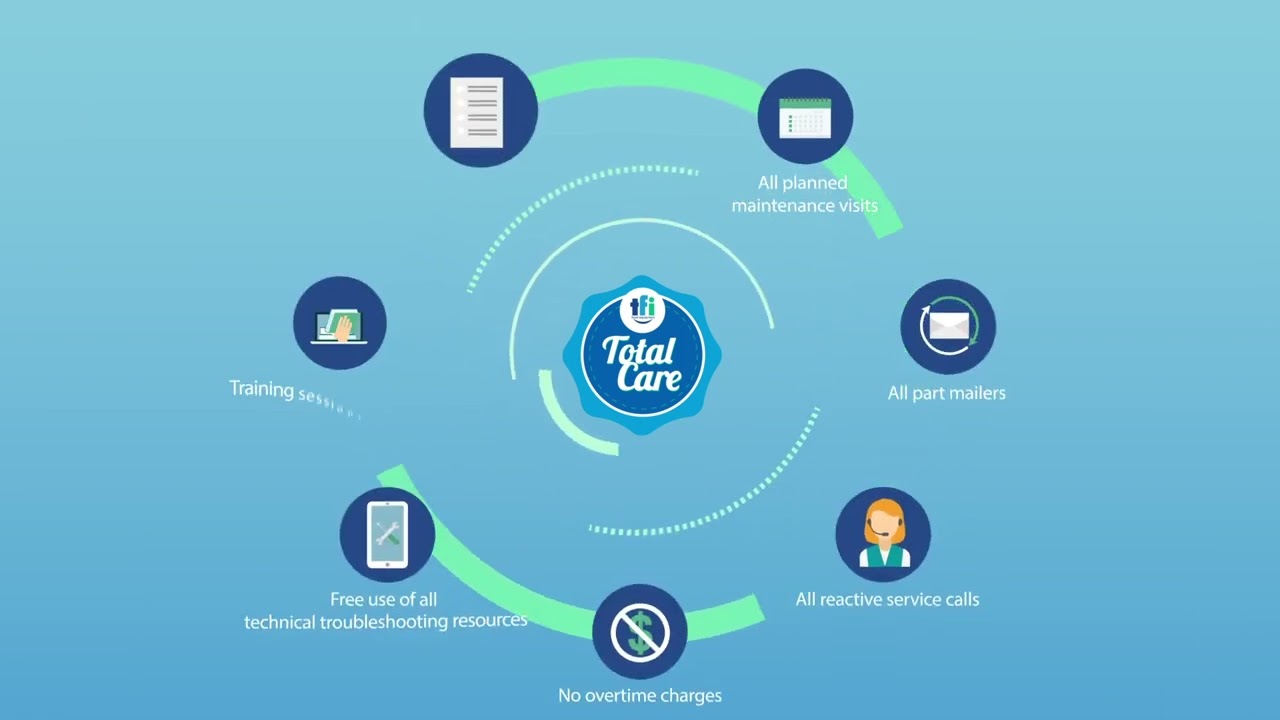
What TFI Total Care actually changes
For operators in Ontario and Atlantic Canada, TFI Total Care changes the economics of breakdowns in four practical ways:
It reduces surprise failures through scheduled maintenance visits.
It gives you reactive support when something does go wrong.
It removes overtime surprises through a predictable monthly structure.
It helps your staff operate equipment better through training and troubleshooting support.
Our repair team supports key foodservice brands and equipment categories, including Taylor®, Henny Penny®, LightFry®, Franke®, and equipment under the Middleby banner such as Pitco, TurboChef, Blodgett, Desmon, HydraRinse, Icetro, Nieco, Perfect Fry, and RAM. We service hot-side, cold-side, and beverage systems across Ontario, Nova Scotia, New Brunswick, Prince Edward Island, and Newfoundland.
When maintenance is enough, and when replacement makes more sense
Not every breakdown should lead to another repair. If the same unit fails repeatedly, parts are becoming difficult to source, or downtime on that station is now a recurring operational risk, the better decision may be replacement. We can support a lower-capital path through restaurant equipment leasing, commercial food equipment rentals, or certified used restaurant equipment. Leasing offers fast approvals, low monthly payments, and 12 to 60 month terms; rentals provide flexible access to used and demo units; and our used equipment includes inspection, testing, and warranty coverage.
That creates a sensible decision tree for operators. If the unit is strategic and repairable, a planned maintenance programme protects uptime. If the unit is unreliable and creating repeated service events, replacing it through a flexible capital structure may be cheaper than continuing to absorb downtime. We cover this decision in more detail in our repair vs. replace guide.
A simple way to think about restaurant equipment maintenance ROI
Ask one question:
What would one peak-service failure cost you this month?
If the answer is anywhere near a month of planned maintenance spend, the maths already favours prevention.
For the average Canadian restaurant, the financial baseline is clear: about $849,200 in annual revenue, about $15,800 in annual repairs and maintenance expense, and only 2.5% net profit. In that environment, equipment uptime is a profit-protection system. That is exactly why commercial kitchen equipment repair services and TFI Total Care should be viewed as operational infrastructure, not optional overhead.
For the average Canadian restaurant earning $849,200 with 2.5% net profit, one Friday-night equipment failure can wipe out more bottom-line income than most owners expect. Equipment uptime is a profit-protection system.
FAQs
How much does a commercial kitchen equipment breakdown cost a restaurant?
It depends on the equipment and timing, but a core-unit outage during a busy service window can easily cost an average Canadian restaurant hundreds of dollars per hour in lost sales, with total impact rising further once labour inefficiency, food waste, refunds, and emergency repair are included. That estimate is grounded in federal revenue and profit data for Canadian restaurants.
Is planned maintenance worth it for small restaurants?
Yes. Smaller operators usually have less redundancy, so one machine failure can remove an entire menu category. With average net margins at 2.5%, even a short outage can do more damage than many owners expect.
What does TFI Total Care include?
TFI Total Care includes reactive service calls, planned maintenance visits, parts logistics, troubleshooting support, training, and no overtime charges under a predictable monthly structure.
What equipment should be on a restaurant equipment maintenance schedule?
Start with mission-critical hot-side, cold-side, and beverage equipment: fryers, ovens, combi ovens, grills, soft serve machines, frozen beverage systems, coffee machines, and related equipment. These are the categories we specifically highlight in our repair and maintenance coverage.
Conclusion
The true cost of a breakdown is rarely the technician's invoice. It is the lost sales during peak periods, the payroll you still carry while output slows, the food you may have to waste, the guests you disappoint, and the emergency service event you could have prevented. For Canadian restaurants operating on narrow margins, that is exactly why restaurant equipment maintenance and planned maintenance for commercial kitchens should be treated as ROI decisions.
Take the next step
We support operators across Ontario, Nova Scotia, New Brunswick, Prince Edward Island, and Newfoundland and Labrador with new equipment sales, certified used equipment, rentals, leasing, installation, training, 24/7 emergency repair, and TFI Total Care planned maintenance programmes.
If you want a more predictable way to protect uptime, reduce service surprises, and keep critical equipment running submit a service request to connect with our factory-trained team.

Nicole Camposeo-Cheung is the Director of Marketing, People & Culture at TFI Food Equipment Solutions, Canada’s leading provider of premium commercial foodservice equipment. She combines her expertise in business management and fashion arts to foster a dynamic, innovative, and people-centric corporate culture. Passionate about empowering teams, building strong client relationships, and driving growth through creativity and collaboration, Nicole plays a key role in shaping TFI’s brand and workplace culture. She also shares her industry expertise and insights through the TFI blog, helping foodservice professionals stay informed about the latest trends, best practices, and innovations in commercial food equipment.
Add a comment
This will be publicly visible.
Your email address will not be published.
Your comment will be reviewed by an admin before it is published.


