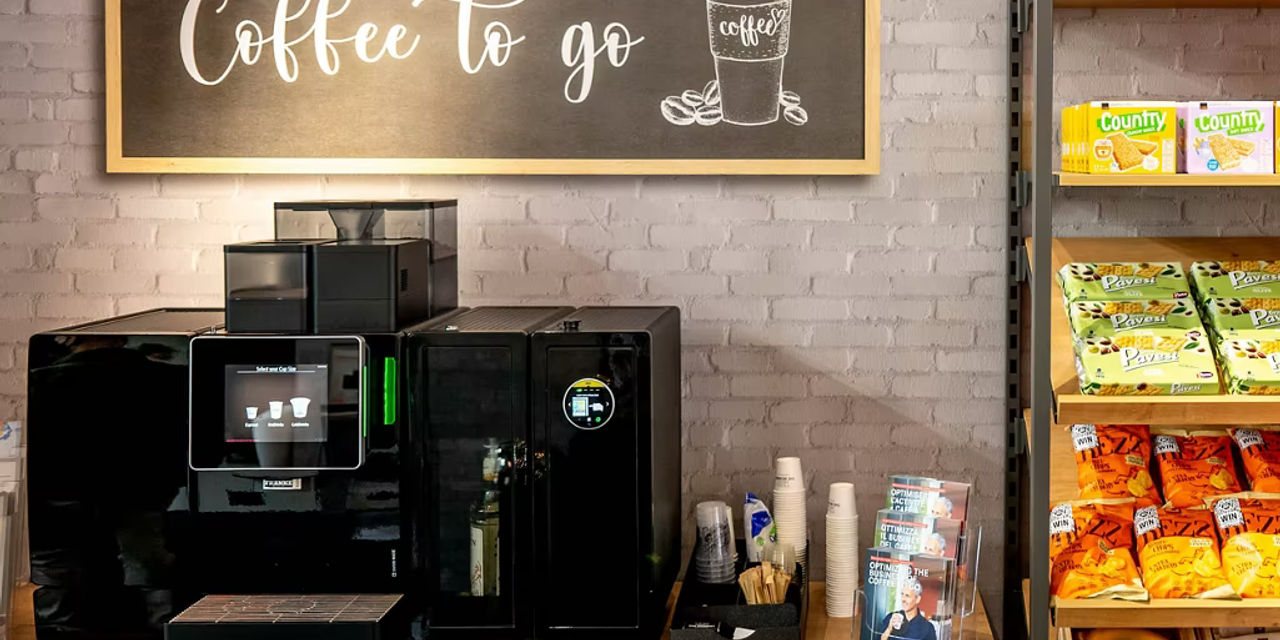
Bean-to-Cup Coffee Machines for Canadian Offices and Businesses: Models, Cost per Cup and Payback
How to size a bean-to-cup coffee machine to your office headcount, what each cup costs against pods and coffee-shop runs, and how the payback works.

A bean-to-cup coffee machine grinds whole beans and brews each drink to order, one cup at a time, with no barista. In a Canadian office, a commercial unit serves 100 to 300 cups a day and produces a milk drink for roughly 40 cents, against the 63 to 85 cents the same coffee costs as a pod and the $5 an employee pays across the street.
That gap is the business case. This guide works through it in order: what each cup costs against pods and a coffee-shop run, what drives the quote on the machine itself, which Franke model fits your headcount, and what payback looks like for an office that gives coffee away rather than sells it.
What a bean-to-cup machine does that pods and drip machines do not
A bean-to-cup machine grinds beans at the moment of the order, doses and tamps them, extracts under pressure, textures milk, and rinses itself between drinks. Ground coffee starts losing aroma within about 90 seconds of grinding, which is why a pod brewed six months after packing and a drip carafe sitting on a warmer both taste flat by comparison.
Three differences matter to a workplace:
Drink range. One machine covers espresso, americano, latte, cappuccino, flat white, mocha and hot chocolate. A drip brewer covers one drink.
Consumables. Whole beans and milk, versus a pod per cup plus the packaging around it.
Cleaning labour. Automated rinse and daily cleaning cycles replace the carafe scrub and the descaling nobody volunteers for.
For the mechanical detail, our explainer on how bean-to-cup coffee machines work covers grind, dose, extraction and cleaning cycles, and the benefits of bean-to-cup coffee machines covers freshness and consistency in full.

Cost per cup: bean-to-cup against pods and the coffee-shop run
A bean-to-cup drink costs a Canadian office roughly 25 cents for a black coffee and 40 cents for a milk drink. The same black coffee costs 63 to 85 cents as a pod and $2.95 at a coffee shop. The milk drink costs over $5.00 across the street.
Keurig Canada's own listed pricing in August 2026 puts a 20 to 24 count box at $14.99 to $16.99 and a 40 to 48 count box at $29.99 to $33.99, which works out to roughly 63 to 85 cents per pod. On the retail side, Square's Canadian transaction data has the average latte past the $5.00 mark, with a standard cup of coffee at $2.95 in the year it measured. An employee buying one latte per working day spends about $1,250 a year on coffee they could have made in the kitchen in 30 seconds.
Run the office numbers at 150 cups a day across 250 working days, or 37,500 cups a year:
Single-serve pods | Bean-to-cup | |
|---|---|---|
Cost per cup | $0.63 to $0.85 | $0.25 black, $0.40 milk drink |
Annual consumable cost | $23,600 to $31,900 | $9,400 to $15,000 |
Drinks available | One per pod SKU stocked | Full espresso and milk menu |
Waste per cup | One pod plus wrapper | Spent grounds only |
Staff time per drink | Load pod, discard pod | Press button |
At 150 cups a day, switching an office from pods to bean-to-cup saves roughly $8,600 to $22,500 a year in consumables alone, before the drink quality or the waste reduction enters the argument.
These figures are illustrative, built from the pod pricing cited above and TFI's $0.40 variable cost assumption for a medium milk drink. Swap in your own invoice and volume and only the size of the gap changes.

What drives the quote on an office bean-to-cup machine
Commercial bean-to-cup pricing is quote-based, and four things move it: daily cup capacity, hopper count, milk system, and whether the machine pours hot and cold. A compact single-boiler unit for a 40-person floor and a triple-boiler machine with FoamMaster and a flavour station sit a long way apart, which is why TFI prices against your volume and menu rather than against a published range.
Very few Canadian offices buy outright. TFI's published benchmark for the A Series is that five to seven cups a day covers a typical monthly lease payment, which turns a capital request into a line on the facilities budget. Terms run 12 to 60 months, and the rent, lease and lease-to-own structures are laid out in our guide to coffee machine rental in Canada.
Two costs get missed at quoting stage. The machine is hard-plumbed to a water line with filtration, because scale is the leading cause of premature boiler failure and hardness varies widely across Ontario and Atlantic Canada. And a fresh-milk machine needs an under-counter cooling unit; Franke's SU05 holds 5 litres, a morning's worth of lattes on a mid-size floor.
Franke bean-to-cup models compared by office size
TFI is the exclusive Franke distributor for Ontario, Nova Scotia, New Brunswick, Prince Edward Island, and Newfoundland and Labrador. The table below is the short version of the Franke A Series range as it applies to workplaces.
Model | Cups per day | Footprint | Milk system | Best-fit office |
|---|---|---|---|---|
Up to 100 | Compact countertop, single boiler, up to 2 hoppers | IndividualMilk, optional 5 L cooler | Under 50 people, satellite floors, boardroom stations | |
Up to 170 | Countertop, single boiler, up to 3 hoppers | IndividualMilk standard, FoamMaster optional | 50 to 150 people, one main kitchen | |
Up to 250 | Countertop, triple boiler, parallel pours | FoamMaster, hot and cold milk | 150 to 300 people, floors with a hard 9 a.m. peak | |
Up to 300 | Countertop, triple boiler, large multi-user screen | FoamMaster with iQFlow | 300 plus people, client-facing lobbies | |
300 plus | Countertop, triple boiler plus Flavor Station | FoamMaster plus powder drinks | Campuses and multi-tenant towers with mixed menus | |
Up to 250 | Countertop, semi-automatic with steam wand | Autosteam, barista-assisted | Hosted client bars where someone pours |
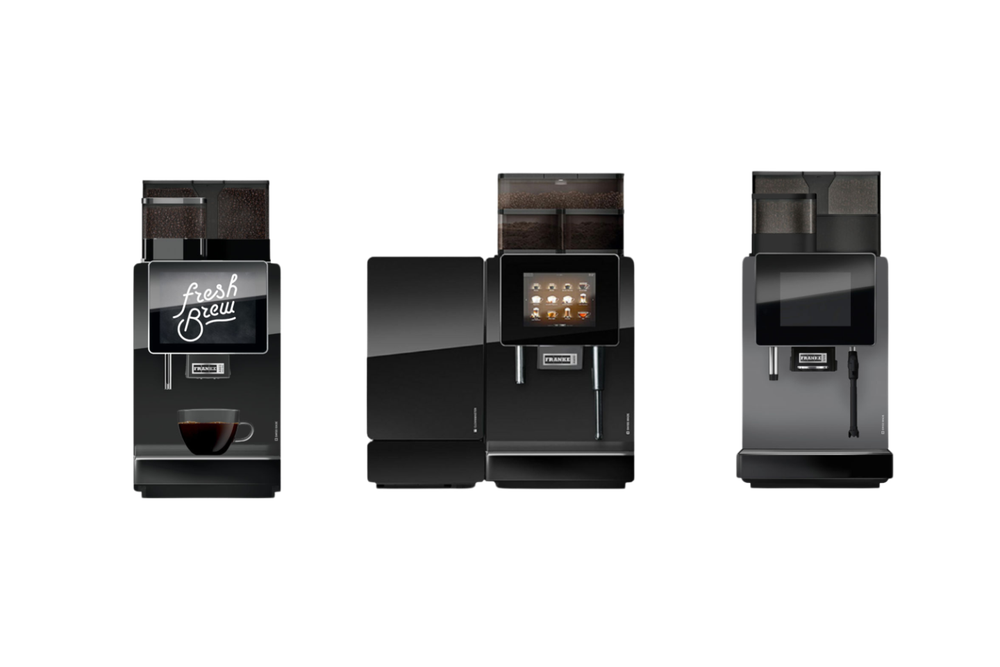
Franke publishes the daily output figures for the A400 at up to 100 cups, the A600 at up to 170, and the A800 at up to 250. The 2025 A-line refresh brought iQFlow extraction control and HeatGuard insulation down to the A600 and A800, narrowing the gap to the flagship to throughput alone. For the tier-by-tier read, see A600 vs A800 vs A1000.
Best bean-to-cup machine by office size, footprint and budget
Size to your peak 15 minutes, not your daily total. A 200-person floor where everyone arrives at 8:45 behaves nothing like a 200-person floor on staggered shifts, and the machine that disappoints is always the one specified on daily average. Our wider guide to automatic coffee machines for offices covers the non-Franke options and the install checklist in more depth.
Best for offices under 50 people: A400 Fresh Brew
Under 50 people, expect 50 to 100 drinks a day and a peak of eight to twelve cups in a quarter hour. The A400 Fresh Brew covers it on a compact countertop, pours espresso and fresh-brew filter coffee from the same beans, and needs the least counter width in the range. It is also the standard second machine near meeting rooms once a larger unit carries the main kitchen.
Best for 50 to 150 people: A600
Most Canadian office floors land in this band, and the A600 is the default answer. Up to 170 cups a day, up to three hoppers so regular, decaf and a light roast run on one machine, and FoamMaster as an upgrade path once the milk mix moves past dairy alone.

Best for 150 to 300 people or a hard morning peak: A800 Fresh Brew
Above roughly 25 to 30 cups in a peak quarter hour, single-boiler machines start queueing because milk and coffee take turns through the system. The A800 Fresh Brew runs a triple boiler and pours in parallel, so an espresso, a filter coffee and a steamed milk drink can be in progress at once. On a floor of 250 people arriving inside a 30-minute window, that is the difference between a line and no line.
Best for client-facing floors and 300 plus people: A1000 and A1000 Flex
The A1000 adds FoamMaster with iQFlow and a large multi-user screen built for self-serve traffic. The A1000 Flex adds a Flavor Station for hot chocolate, chai and specialty lattes from the same unit, which is what campus dining and multi-tenant towers usually need once the machine has to satisfy more than coffee drinkers.
Best for a tight counter or a tight budget
If counter width is the constraint, the A400 is the narrowest cabinet in the range and the only model that does not assume an under-counter fridge. If capital is the constraint, lease-to-own over 12 to 60 months, a short-term rental on one floor first, or certified pre-owned A Series with warranty all get a machine in place without a capital request. The choice between an automated machine and a traditional setup with a person behind it is covered in super-automatic vs traditional espresso.

Payback math for an office coffee program
An office coffee program pays back differently from a café, because most offices give the coffee away. The return is cost avoidance and retention, not gross margin, unless the machine is metered or client-facing.
Both cases are worth modelling honestly:
The office that gives coffee away. The saving is the consumable gap plus whatever the current coffee service contract costs. At 150 cups a day the pod-to-bean gap alone runs $8,600 to $22,500 a year, and that is the figure to set against the lease payment on your quote. Below roughly 40 cups a day the arithmetic tightens and the case leans harder on drink quality, waste reduction, and an employee not leaving the building for a $5 latte.
The office that recovers cost, or serves clients. Add cashless payment for partial or full cost recovery, or count the coffee as hospitality on a client-facing floor, and the economics move to TFI's standard commercial numbers: 80 percent-plus gross profit per cup and a 6 to 12 month payback. Segment-by-segment margin and payback ranges for offices against cafés, QSR and c-stores sit in commercial coffee program ROI by segment.
The demand side supports the spend either way. The Coffee Association of Canada's most recent Canadian Coffee Drinking Trends study found 71 percent of Canadians drank a coffee beverage the previous day, with 29 percent having an espresso-based drink. Nearly a third of your staff want a latte, not a filter coffee, and a drip carafe cannot serve them.

What to confirm before install
A site survey takes an hour and prevents the two failure modes that actually happen: a machine that cannot be plumbed where the counter is, and a milk fridge with nowhere to sit.
Water. A dedicated line, a shutoff, and filtration sized to local hardness. Plumbed-in beats a fill tank above about 30 people.
Drainage. Rinse cycles produce waste water. Either a drain connection or a waste container someone empties.
Power. A dedicated circuit per machine, not a shared power bar.
Counter and clearance. Cabinet width plus service access, plus the under-counter cooling unit on any fresh-milk configuration.
Placement. Grinders are quiet by commercial standards but not silent. Keep the machine off a shared wall with meeting rooms.
Uptime after install is a service question, not a machine question. TFI runs more than 100 factory-trained technicians across Ontario and Atlantic Canada with OEM Franke parts, and TFI Total Care folds planned maintenance, descaling and parts into one predictable monthly cost.
Bean-to-cup coffee machine FAQs
Are bean-to-cup coffee machines worth it for an office?
For any office serving more than about 40 drinks a day, yes on consumables alone. Bean-to-cup ingredients run roughly 25 to 40 cents a cup against 63 to 85 cents for a pod, which at 150 cups a day is a saving of $8,600 to $22,500 a year. Below roughly 40 cups a day the consumable saving takes longer to cover a commercial machine, and a rental is the better first step.
How much does a commercial bean-to-cup coffee machine cost in Canada?
Pricing is quote-based, because the model, milk system, hopper count and flavour options all move the number, and installation depends on the water and power already at the site. What TFI gives you up front is the ROI frame: most Canadian offices lease rather than buy on terms from 12 to 60 months, and the benchmark is that five to seven cups a day covers a typical monthly lease payment. Ask for a quote modelled on your own headcount and volume.
What size bean-to-cup machine does my office need?
Size to peak demand, not daily total. Under 50 people, the A400 Fresh Brew at up to 100 cups a day. Between 50 and 150 people, the A600 at up to 170. Between 150 and 300 people or on any floor with a hard morning peak, the A800 Fresh Brew at up to 250 cups with parallel pouring. Above 300, the A1000 or A1000 Flex.
Does a bean-to-cup coffee machine need to be plumbed in?
Commercial units should be. A plumbed line with filtration removes the daily refill task, protects the boiler from scale, and is required for consistent output above about 30 cups a day. Filtration is not optional across most of Ontario and Atlantic Canada, where water hardness varies enough to shorten boiler life materially.
What coffee beans work in a bean-to-cup machine?
Any whole bean roasted for espresso or filter, provided it is not oily enough to clog the grinder. Very dark, visibly oily roasts are the common cause of grinder and chute problems in office machines. Machines with two or three hoppers let you run regular, decaf and a lighter roast at the same time, which is usually enough to end the debate on your floor.
How is bean-to-cup different from an instant coffee vending machine?
An instant vending machine reconstitutes soluble coffee powder with hot water. A bean-to-cup machine grinds whole beans per drink and extracts them under pressure. That is the difference between instant coffee and café coffee, and it is the main reason offices replacing a vending unit see usage jump after the switch.
Can we rent a bean-to-cup coffee machine for one office before rolling it out?
Yes. TFI rents commercial coffee equipment on short-term and month-to-month agreements with service and parts included, which is the standard way multi-floor and multi-site employers validate demand on one location before committing capital across the portfolio.
Getting a machine specified for your floor
TFI Food Equipment Solutions has supplied Canadian foodservice for more than 60 years and is the exclusive Franke distributor across Ontario, Nova Scotia, New Brunswick, Prince Edward Island, and Newfoundland and Labrador, with showrooms in Mississauga and Dartmouth. The same team specifies the machine, installs it, trains your staff and services it afterwards, on financing terms from 12 to 60 months.
Bring your headcount, your peak-hour arrival window and your current coffee invoice. Ask our team to model the cost per cup for your site, or book a live pour on the model you are considering before anything is ordered.

Nicole Camposeo-Cheung is the Director of Marketing, People & Culture at TFI Food Equipment Solutions, Canada’s leading provider of premium commercial foodservice equipment. She combines her expertise in business management and fashion arts to foster a dynamic, innovative, and people-centric corporate culture. Passionate about empowering teams, building strong client relationships, and driving growth through creativity and collaboration, Nicole plays a key role in shaping TFI’s brand and workplace culture. She also shares her industry expertise and insights through the TFI blog, helping foodservice professionals stay informed about the latest trends, best practices, and innovations in commercial food equipment.
Add a comment
This will be publicly visible.
Your email address will not be published.
Your comment will be reviewed by an admin before it is published.


