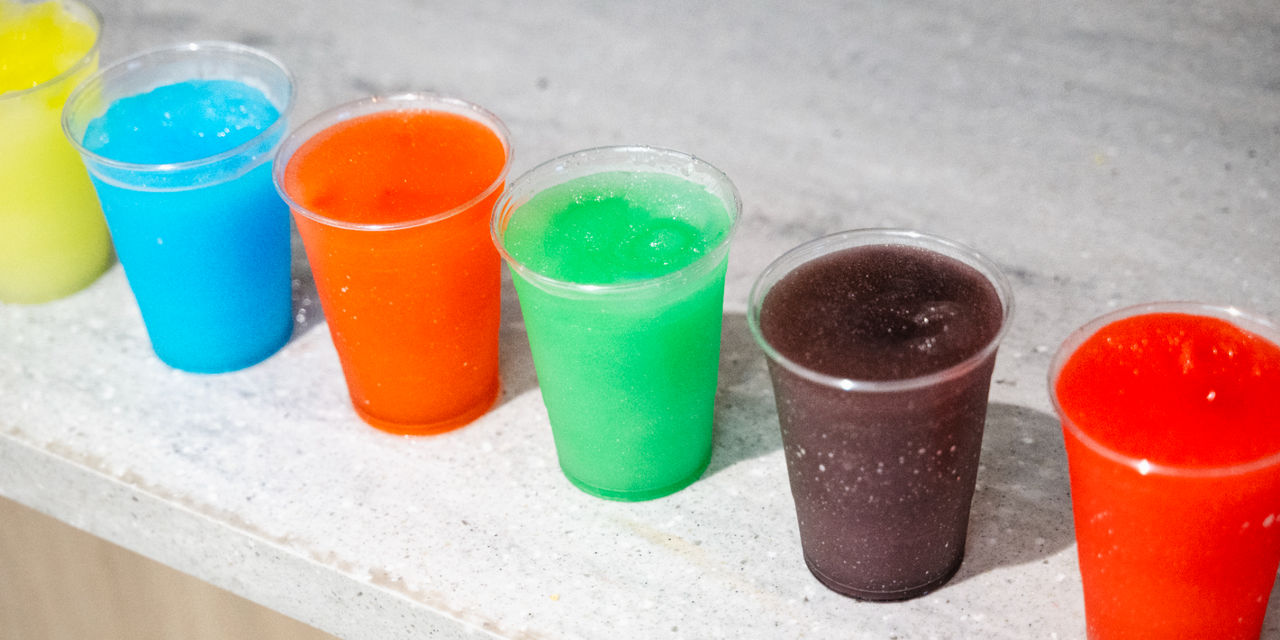
Commercial Slushie Machines in Canada: Sizing, Cost per Cup, and Profit Maths
How to size a commercial slushie machine in Canada by cup volume, what each slushy costs to make, and the margin and payback maths behind the programme.

A commercial slushie machine is sized by the volume of its freezing cylinder and how fast that cylinder recovers, not by the size of the hopper you can see from the front of the store. That single distinction decides whether your machine keeps up on a hot Saturday afternoon or runs thin by two o'clock. A Taylor 0340 carries a 7 quart, 6.6 litre freezing cylinder, which is roughly fourteen 16 oz servings of finished product before the machine is working purely on recovery, no matter how much unfrozen mix is sitting in the reservoir above it.
Most buying guides skip that number. This one starts there, then works forward through throughput, cost per cup, and payback, so you can size a machine against your actual peak hour instead of a brochure photo. If you want help modelling it against your site, TFI's team will run the numbers with you. The full Taylor range is on our commercial slush machines page.
What a commercial slushie machine is, and how it differs from a home slushy machine
A commercial slushie machine is a refrigerated beverage freezer that continuously churns a sugar and water solution inside a sealed freezing cylinder, holding it at a semi-frozen consistency and dispensing it on demand through a valve. Home units, including the countertop appliances that dominate consumer search results, freeze a single small batch and then stop. Commercial machines never stop. They hold product in a serve-ready state through an entire trading day, refreeze what the last customer drew, and are built for thousands of cycles rather than a few dozen.
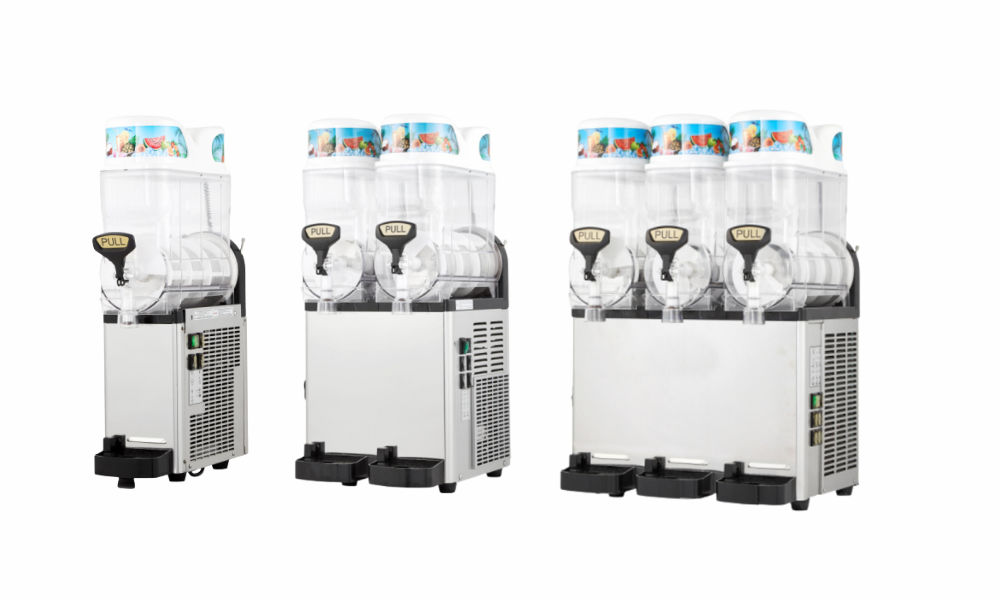
Three differences matter when you are comparing them:
Continuous duty. A commercial cylinder is refrigerated and beaten constantly, so the product stays at serving consistency between customers. A home appliance produces a batch, then needs to run again.
Recovery rate. Commercial compressors are specified in Btu because refreezing drawn product quickly is the whole job. Taylor slush freezers run from 6,000 Btu on a small countertop model up to 18,000 Btu on multi-flavour carbonated units.
Sanitation design. Commercial machines are built to be stripped, cleaned, and reassembled on a schedule by staff who have been trained on them, which is what keeps a health inspector satisfied.
If your question is which specific model suits your menu, the commercial slush machine buying guide covers model selection in detail. This article is about the numbers underneath that choice.
How does a slushie machine work? The freeze cycle behind every cup
A slushie machine works by holding a sweetened liquid just below the freezing point of water and scraping ice crystals off the cylinder wall before they can lock together into a solid block. Sugar is what makes that possible. Dissolved sugar lowers the temperature at which a solution freezes, a colligative property that chemists call freezing point depression, and the effect scales with how much solute is in the mix.
That is why brix, the measure of sugar concentration in the mix, is not a detail you can be casual about. Dilute the syrup too far and the product freezes hard and jams the beater. Run it too sweet and it never sets, so you serve cold juice. Taylor builds its slush freezers around consistent brixing and repeatability for exactly this reason, and a machine that drifts off brix will quietly cost you both product and customers.
The beater motor turns an auger that keeps scraping the cylinder wall. Draw a cup, and warmer mix flows in from the reservoir; the compressor then has to pull that new volume down to serving temperature. The speed of that cycle is your real capacity ceiling. Our explainer on how slush machines work goes deeper on the mechanism.

Commercial slushie machine sizing: freezing cylinder capacity versus daily cup volume
Size the machine on cylinder volume per flavour, then check it against your peak hour. Here are the published Taylor figures, which give you a concrete starting point.
Taylor model | Flavours | Carbonated | Installation | Freezing cylinder | Mix reservoir |
|---|---|---|---|---|---|
0430 | 1 | No | Countertop | 4 qt / 3.8 L | 14 qt / 13.2 L |
0340 | 1 | No | Countertop | 7 qt / 6.6 L | 20 qt / 18.9 L |
0428 | 1 | No | Countertop with optional cart | 7 qt / 6.6 L | 20 qt / 18.9 L |
0342 | 2 | No | Floor | 7 qt / 6.6 L per barrel | 20 qt / 18.9 L |
0432 | 2 | No | Countertop with optional cart | 4 qt / 3.8 L per barrel | 12 qt / 11.4 L |
C393 | 3 | Yes | Countertop with optional cart | 7 qt / 6.6 L per barrel | Bag-in-box fed |
0349 | 4 | Yes | Floor | 7 qt / 6.6 L per barrel | Bag-in-box fed |
C314 | 4 | Yes | Countertop with optional cart | 7 qt / 6.6 L per barrel | Bag-in-box fed |
Source: Taylor slush freezer specifications.
Convert those litres into cups and the picture sharpens. A 6.6 L cylinder holds roughly 14 servings at 16 oz (473 mL), about 18 at 12 oz, and about 11 at 20 oz. The smaller 3.8 L cylinder on the 0430 and 0432 holds roughly eight 16 oz servings. Icetro's slush machines take a different approach with 3.2 gallon bowls across one to three barrels, which is about 12.1 L, or roughly 25 servings at 16 oz per bowl.
A 20 qt mix reservoir sounds generous, and it is: about 40 servings' worth of 16 oz product. But that mix is unfrozen. It is inventory, not capacity. Only the 6.6 L in the freezing cylinder is ready to sell.
Here is the trap on multi-barrel machines. A four-flavour Taylor 0349 holds about 56 servings across four cylinders, but only about 14 of any single flavour. If blue raspberry is half your slushie sales, and it usually is in Canada, four barrels does not solve a blue raspberry problem. Two barrels running the same flavour will serve a rush that four different flavours cannot. Check your own POS data on flavour split before you spec barrel count, and see our ranking of the most popular slushie flavours in Canada if you are building the menu from scratch.
Use daily volume as the first filter, then confirm against peak hour:
Daily 16 oz servings | Typical peak-hour draw | Sensible starting spec |
|---|---|---|
Under 40 | Under 10 | Single-flavour countertop, 3.8 L cylinder |
40 to 100 | 10 to 25 | Single or two-flavour, 6.6 L cylinder |
100 to 250 | 25 to 60 | Two to four barrels, floor model |
250 and up | 60 and up | Multiple multi-barrel units, or a high-output carbonated line |
If you do not yet have POS data to work from, a reasonable planning assumption is that your busiest hour carries around a quarter of the day's cups, and more than that at a venue with event traffic. Pull the real figure from your till the moment you have it. That is the number that decides whether your machine embarrasses you.

How many slushies a machine serves per hour
Sustained hourly output equals the cylinder's ready volume plus whatever the compressor can refreeze during that hour. Once you have drawn the cylinder down, throughput is a recovery problem, and recovery is a function of compressor capacity, ambient temperature, and how cold the incoming mix is.
Three things you can control will move that number more than the model badge on the front:
Pre-chill the mix. Mix that goes into the reservoir at room temperature forces the compressor to do work it should not have to. Refrigerated mix meaningfully shortens recovery.
Give the machine air. Manufacturers specify clearance around the condenser for a reason. A unit boxed into a corner behind a stack of cases will run hot, recover slowly, and fail early.
Watch ambient heat. A machine parked beside a hot-food merchandiser or in direct summer sun through a storefront window is fighting the room all day.
The classic sizing mistake is buying on total litres. A machine with a big visible hopper and a modest compressor looks impressive and disappoints at 2 pm on the first hot Saturday in July. Our frozen beverage machine buyer's guide walks through matching throughput to footprint across c-store and QSR formats.

Slushie machine cost per cup: what each serving actually costs to make
Cost per cup is the sum of concentrate, cup, lid, straw, and, on carbonated machines, CO2. Build it once for your own supplier pricing and you will never have to guess at a menu price again.
The formula:
Cost per cup = (concentrate cost ÷ servings yielded per unit) + cup + lid + straw + CO2 per serve
Concentrate yield is the input operators most often get wrong, and it is worth pulling the real number from your supplier rather than estimating. As a reference point for how far concentrate goes, TFI's Flavor Burst flavour injection system yields up to 435 slush servings from a single gallon of concentrated syrup, and an eight-flavour loadout produces roughly 3,480 servings before the first syrup change.
Here is the calculation with placeholder inputs, so you can see the shape of it. Replace every figure below with your own supplier pricing; these are illustrative, not quotes.
Line item | Illustrative cost per 16 oz cup |
|---|---|
Concentrate | $0.30 |
Cup | $0.11 |
Lid | $0.04 |
Straw | $0.02 |
CO2 (carbonated units only) | $0.02 |
Total variable cost | $0.49 |
Against a $3.49 menu price, that illustrative cup carries $3.00 of gross profit, or about 86%. Run the same arithmetic at your own costs and your own price point. The reason the exercise is worth twenty minutes is that slushies are one of very few foodservice items where a five cent change in packaging cost is visible in the annual number, because you sell so many units.
Two costs people forget: the product left in the cylinder at close if you dump rather than hold, and the water and labour in the cleaning cycle. Neither is large per cup. Both are real.
Slushie machine profit margins and payback in Canada
Frozen beverage programmes built on Taylor equipment typically run 70% to 80% gross profit with payback in six to 18 months, which puts them among the fastest-returning pieces of equipment in a Canadian foodservice operation. The payback window is wide because it depends almost entirely on volume, and volume depends on placement.
Work it in this order:
Establish your realistic daily cup count from comparable sites or a trial period.
Multiply by gross profit per cup from the section above.
Divide the installed equipment cost by monthly gross profit to get payback in months.
A site selling 60 cups a day at $3.00 gross profit generates about $5,400 a month in gross profit from a single machine. A site selling 15 cups a day generates about $1,350. Those two operators should not be buying the same machine, and they should not be financing it the same way either.
Cost is the objection that stalls most of these decisions, and it does not need to. Leasing and financing let the programme's own margin cover the payments from month one, which is why so many c-store operators structure it that way. If the budget is genuinely tight, certified used commercial slush machines come with warranty and shorten the payback further. For a fuller treatment of the business model, see our guide to running a profitable slush business in Canada.

Carbonated versus uncarbonated slushy machines: which one to install
Carbonated machines inject CO2 into the product for the sparkling, Slurpee-style texture; uncarbonated machines produce the smooth, still slush most people picture when they think of a fruit slushie. Both sell. They suit different sites.
Choose carbonated when you are running a cola or soft-drink-branded programme, when customers expect that specific fizzy mouthfeel, and when you have somewhere to put a CO2 supply and the willingness to manage it. Taylor's carbonated line includes the four-flavour 0349 and C314 and the three-flavour C393, all built around 7 quart cylinders per barrel and available through TFI as frozen carbonated beverage freezers.
Choose uncarbonated when your menu leans fruit, when you also want to run frozen coffee, frozen tea, or smoothies through the same barrel, or when you want the simpler installation. Uncarbonated units need no gas line and no cylinder management, which matters in a small back-of-house. Our breakdown of slush machine types and use cases compares the configurations side by side.
The versatility argument usually settles it for independents. One uncarbonated barrel that sells blue raspberry in July and frozen mocha in October earns twelve months a year instead of four.
Where a commercial slushie machine earns the most in Canada
Convenience stores are the strongest placement, and the channel data explains why. Canadian convenience retail is an $11.3 billion market across more than 7,500 stores, and the channel is expected to contribute more than $4 billion to Canada's foodservice industry in 2026 as operators push further into prepared food and beverages. A frozen beverage bar is one of the cheapest ways into that shift, because it needs a metre of counter, a power outlet, and no kitchen.
Canadian appetite for the category is not seasonal folklore either. Winnipeg, a city of about 850,000, gets through an average of 188,833 Slurpees a month and has held 7-Eleven's Slurpee Capital of the World title for more than twenty years on a per-store basis. Canadians drink frozen beverages in February.
Restaurants and QSRs are the second-strongest placement. Statistics Canada put Canadian food services and drinking places sales at $8.8 billion in February 2026, with Ontario alone at $3,429.5 million and Nova Scotia up 2.5% month over month, so there is a large and growing base of operators looking for high-margin add-ons that do not add labour. A slushie machine is self-serve or single-button service; it does not need a trained cook.
Placement rules that consistently hold:
Put the machine where customers already queue, not in a quiet corner. Visibility drives impulse purchase, and impulse is most of this category.
Keep it away from heat sources and out of direct sun.
Leave manufacturer-specified clearance for the condenser, even when floor space is tight.
Position cups, lids, and straws within arm's reach of the valve so the transaction takes seconds.
For a channel-specific treatment, read our slush machine guide for convenience stores, or the wider view in building a profitable convenience store beverage programme.
What quietly erodes slushie machine margins
Downtime does most of the damage, and almost all of it is preventable. A machine that is not freezing is not a mystery in most cases; it is one of four things.
Brix drift. If the mix is too dilute, the product will not set. Check the ratio before you call anyone.
A dirty condenser. Dust-blocked coils are the single most common cause of poor freezing and slow recovery. Cleaning them is a five minute job on a schedule.
Worn scraper blades. Blades that no longer scrape the cylinder wall cleanly leave an insulating ice layer and kill both texture and recovery.
Restricted airflow. See the clearance point above. It comes back around.
Cleaning cadence is the other quiet cost. Follow the manufacturer's schedule, because a shortened clean saves twenty minutes today and costs a barrel of product when the machine has to come down mid-shift. Train more than one person on the strip-down; programmes fail when the only staff member who knows the machine leaves.
When something does go wrong, response time is the whole game on a unit holding product that has to stay cold. TFI runs 24/7 repair with factory-trained technicians using OEM parts across Ontario and Atlantic Canada, and TFI Total Care folds scheduled maintenance, repairs, and parts into one predictable monthly cost so a failed compressor is not a surprise line in your P&L.
Commercial slushie machine questions Canadian operators ask
How much does a commercial slushie machine cost?
Installed cost depends on barrel count, carbonation, and whether the unit is countertop or floor-standing, so figures quoted online rarely match what a Canadian operator pays once installation and training are included. TFI quotes by configuration and can structure the purchase as a lease, a rental, or a certified used machine. Request a quote with your daily cup target and you will get a number that reflects your site.
How long does a slushie machine take to freeze?
Initial freeze-down from a fresh fill typically runs longer than the recovery cycle during service, because the machine is pulling a full cylinder of room-temperature mix down to serving consistency. Pre-chilling your mix shortens it noticeably. Plan the first fill well before opening rather than during it.
Is a slushy business profitable?
Gross margins on frozen beverages are among the highest in foodservice, in the 70% to 80% range on Taylor programmes. Whether that translates into a profitable business depends on volume and placement, which is why the sizing and cost-per-cup work above matters more than the headline margin.
What is the difference between a slushie machine and a slush machine?
Nothing. "Slushie" and "slushy" are the consumer spellings, "slush machine" is the industry term, and equipment manufacturers use "frozen beverage freezer" on the spec sheet. They describe the same category of machine.
Can one machine run more than slush?
Yes, on uncarbonated models. The same barrel will run frozen coffee, frozen tea, smoothies, and frozen cocktails, which is how operators keep the equipment earning through a Canadian winter.
Do I need a carbonated machine to sell slushies?
No. Uncarbonated machines produce the classic smooth slush and are simpler to install and run. Carbonation is a texture choice tied to soft-drink-branded programmes, not a requirement.
Put real numbers on your slushie programme before you buy
Everything above comes down to two figures: how many cups your site sells in its busiest hour, and what each cup earns you. Get those right and the machine almost specifies itself.
TFI has supplied Canadian foodservice operators for more than 60 years and sells, installs, trains on, and services Taylor and Icetro frozen beverage equipment across Ontario, Nova Scotia, New Brunswick, Prince Edward Island, and Newfoundland and Labrador, from showrooms in Mississauga and Dartmouth. Bring us your daily cup target and we will size the machine, model the payback, and show you the lease or rental structure that fits.
Talk to TFI about a slushie programme, or book a chef demo in Mississauga and taste the product off the machine you are considering before you commit to it.

Nicole Camposeo-Cheung is the Director of Marketing, People & Culture at TFI Food Equipment Solutions, Canada’s leading provider of premium commercial foodservice equipment. She combines her expertise in business management and fashion arts to foster a dynamic, innovative, and people-centric corporate culture. Passionate about empowering teams, building strong client relationships, and driving growth through creativity and collaboration, Nicole plays a key role in shaping TFI’s brand and workplace culture. She also shares her industry expertise and insights through the TFI blog, helping foodservice professionals stay informed about the latest trends, best practices, and innovations in commercial food equipment.
Add a comment
This will be publicly visible.
Your email address will not be published.
Your comment will be reviewed by an admin before it is published.


