
Commercial Griddles and Flat Top Grills in Canada: Gas vs Electric, Sizing and Clamshell Options
A Canadian buyer's guide to commercial griddles and flat top grills: gas vs electric, sizing by covers per hour, single-sided vs clamshell, controls, cleaning, and Taylor L800 series specs.

A commercial griddle is a flat, heated metal plate used to cook burgers, eggs, pancakes, sandwiches, and vegetables in volume, and it is the same piece of equipment many Canadian operators call a flat top grill or a flat grill. Choosing one comes down to five decisions: gas or electric, width and heat input for your busiest hour, single-sided flat top or two-sided clamshell, manual or thermostatic controls, and how your crew will clean it every night. This guide works through each decision using manufacturer specifications from Taylor, whose L800 series two-sided grills TFI supplies and services across Ontario and Atlantic Canada.
The stakes are real. Canadian food services and drinking places sold $101.4 billion in 2025, up 5.6% from 2024, and burgers and fries remain the most-ordered menu category, while the chicken sandwich posted 26% more servings than in 2020. Burgers, chicken sandwiches, and breakfast sandwiches are griddle products, so the plate you choose sets the pace of your line. If you already know you want two-sided cooking, browse the Taylor commercial grills TFI carries.
Key takeaways: Gas or electric is mostly a question of what your building can supply. Size to your busiest hour, not your average day. A Taylor two-sided grill can be a size class narrower than a single-sided griddle because it cooks from both sides at once. And because Taylor's controls switch each menu item between clamshell and flat cooking, one unit can cover both jobs.
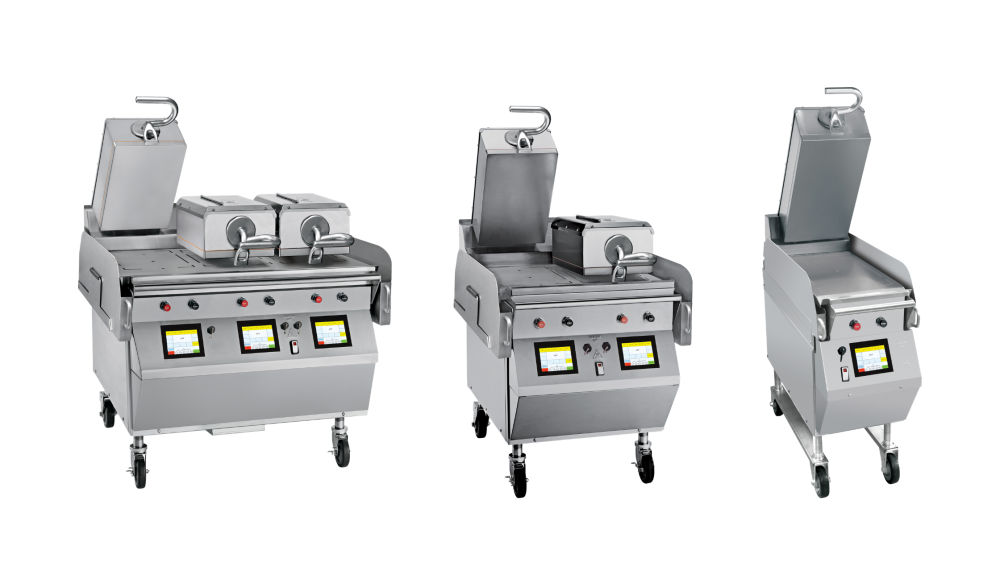
Commercial Griddle, Flat Top Grill, or Flat Grill: What Is the Difference?
In commercial kitchens, a griddle, a flat top grill, a flat grill, and a flat top griddle are the same thing: a thick metal plate heated from below by gas burners or electric elements. The names reflect regional and brand habits, not different equipment. A charbroiler is the one that differs, because it cooks over open grates and leaves grill marks.
The split that matters is single-sided versus two-sided cooking. A single-sided griddle heats only the plate, so the cook flips product by hand. A two-sided grill, usually called a clamshell grill, adds one or more heated upper platens that lower onto the food and cook the top at the same time. Taylor's operator manual describes its L800 series grills as providing "all the features of a flat grill as well as the advantages of two-sided cooking".
Term | What it means | Typical menu use |
|---|---|---|
Commercial griddle / flat top griddle | Heated flat plate, single-sided | Eggs, pancakes, burgers, sandwiches, vegetables |
Flat top grill / flat grill | Same equipment, different name | Same as above |
Clamshell grill / two-sided grill | Flat lower plate plus heated upper platen(s) | High-volume burgers, chicken, breakfast sandwiches |
Charbroiler | Open grates over radiant heat | Grill-marked steaks and burgers (not a griddle) |
Gas vs Electric Commercial Griddles
Gas or electric is mainly a question of what your building can supply. A gas griddle needs a gas line, a licensed gas fitter, and venting clearances. An electric flat top grill needs a large dedicated electrical circuit. Both cook well, and both normally sit under a grease-rated exhaust hood, so confirm hood and fire suppression requirements with your local building and fire officials before you order.
One detail catches buyers out: Taylor's gas two-sided grills are hybrids. The L811, L813, L819, and L821 heat the lower plate with gas and the upper platens with electricity, so they need both utilities. The L810, L812, L820, L822, and L828 are fully electric. The comparison below uses figures from Taylor's spec sheets and ENERGY STAR.
Factor | Gas griddle | Commercial electric griddle |
|---|---|---|
Heat source | Burners under the plate. Taylor gas models use ceramic infrared burners rated 25,000 BTU/h per 12-inch cook zone | Elements under the plate. Taylor electric models use three independent elements per cook zone, plus two in each upper platen |
Utility hookups | Gas line plus power. Taylor gas models still need one dedicated electrical connection for the platens and controls | Power only. Taylor's 36-inch L812 needs two dedicated electrical connections |
Taylor examples | L813: 75,000 BTU/h plus 6 kW. L819: 50,000 BTU/h plus 6 kW | L820: 17 kW. L810: 22.5 to 27 kW. L828: 8.3 to 9 kW |
Fuel options | Natural gas or propane (Taylor manifold pressure 3.5 in. w.c. natural, 10.5 in. w.c. propane) | 208V or 240V, single-phase or three-phase depending on model |
ENERGY STAR certified savings (US estimates) | 17% more efficient, about US$360 a year | |
Strong fit | Kitchens with existing gas service; propane for rural and seasonal sites | Kitchens without gas, food halls, sites with spare electrical capacity |
In Ontario, gas appliances must be installed by a TSSA-certified gas technician, and electrical work needs an ESA notification filed by a licensed electrical contractor. Nova Scotia, New Brunswick, PEI, and Newfoundland and Labrador each license gas fitters and electricians under their own provincial rules. Before deciding, run a one-year utility comparison at your local natural gas and electricity rates against the unit's BTU or kW rating.
For gas-specific installation and ventilation detail, see our commercial gas flat top grill buyer's guide.
Sizing a Commercial Flat Top Griddle by Covers per Hour
Size a commercial griddle to your busiest hour, not your average day. Count the grilled items you sell in the peak 60 minutes (here, one cover means one guest order with one grilled item), then pick the width and heat input that keeps pace without holding product.
Most single-sided gas griddles run one burner for every 12 inches of plate, typically rated between 20,000 and 30,000 BTU/h. Taylor's gas two-sided models sit in the same range at 25,000 BTU/h per 12-inch zone, but add electric heat from above. Taylor states that two-sided cooking cuts cook times by up to 50% compared with traditional flat top grills, which means each inch of Taylor plate can turn over up to twice as much product. The table maps each Taylor model one size class up, which is a conservative match.
Peak-hour grill covers | Single-sided griddle width | Single-sided gas heat input (approx.) | Taylor two-sided equivalent | Taylor heat input |
|---|---|---|---|---|
30 to 60 | 24 in | 40,000 to 60,000 BTU/h | L828: 8.3 to 9 kW. L821: 50,000 BTU/h plus 3 kW. L822: 14 kW | |
60 to 100 | 36 in | 60,000 to 90,000 BTU/h | L819: 50,000 BTU/h plus 6 kW. L820: 17 kW | |
100 to 200 | 48 in | 80,000 to 120,000 BTU/h | L813: 75,000 BTU/h plus 6 kW. L812: 20 to 25 kW | |
200 to 350 | 60 in | 100,000 to 150,000 BTU/h | L811: 75,000 BTU/h plus 8 to 9 kW. L810: 22.5 to 27 kW | |
350+ | 72 in, or two griddles | 120,000 to 180,000 BTU/h | Two 36-inch Taylor units, or one Taylor plus a flat top for breakfast and limited-time items | Modelled on your menu |
Treat the table as a starting point and confirm it with a menu-specific throughput model. Three practical checks apply to every install:
Depth, not just width. Taylor's 36-inch grills are 40-5/16 inches wide and 38-13/16 inches deep (electric) or 40-13/16 inches deep (gas), deeper than most countertop griddles. Measure your hood line and equipment row before you commit.
Aisle clearance. Taylor specifies a minimum 34-inch (86.4 cm) aisle in front of the grill so staff can remove the grease cans.
Flue clearance on gas models. Taylor's gas models need 3 inches (7.6 cm) from the back wall to the flue deflector.
Single-Sided Flat Top vs Two-Sided Clamshell Grill
A single-sided flat top is the more flexible, lower-cost tool, and a two-sided clamshell grill is the faster, more consistent one. The right choice depends on how much of your grill volume is repeatable proteins versus made-to-order variety.
Factor | Single-sided commercial flat top grill | Two-sided clamshell grill (Taylor L800 series) |
|---|---|---|
How it cooks | Heat from below; the cook flips by hand | Heat from below and above; the platen lowers to a programmed gap |
Speed | Baseline | Up to 50% shorter cook times across the menu; two-thirds faster on a frozen patty (Taylor) |
Consistency | Depends on the cook | One touch sets time, temperature, and gap for every product |
Menu flexibility | Anything that fits on the plate | Clamshell and flat modes, with up to four flat items timed per zone |
Training | Needs an experienced grill cook | Recipes are stored in the control, so new staff get up to speed faster |
Upfront cost | Lower | Higher |
Daily cleaning | Scrape, degrease, re-season | Plate, platens, and release sheets, with a Clean mode that cools to a safe temperature |
A single-sided griddle is the right call for breakfast-heavy menus built on eggs and pancakes, low-volume sites, tight budgets, and menus that change weekly. A clamshell grill pays off when the peak hour runs on repeatable proteins, when drive-thru times matter, when labour is tight, and when a multi-unit brand needs every location producing the same burger. Plenty of operators run both: a two-sided grill for core proteins and a small flat top for specialty builds.

Taylor L800 Series Two-Sided Grills: The Throughput Option
For operators whose peak hour is built on burgers, chicken, and breakfast sandwiches, a Taylor L800 series two-sided grill is the throughput option. Taylor's product copy, as published by its factory-appointed distributors, states that its "revolutionary two-sided grilling cooks a frozen patty two-thirds faster than traditional flat grills". That is the roughly 66% gain behind our commercial flat top grill guide for smash burgers. Taylor's current grills page gives the broader, all-menu figure more conservatively: cook times reduced by up to 50% versus traditional flat top grills.
In practice, at Taylor's conservative 50% figure, a grill station that turns eight loads of patties an hour on a flat top can turn up to sixteen on a two-sided grill, with the same cook. That is the difference between adding a second grill position at lunch and not needing one.
TFI carries nine Taylor L800 series models. The specifications below come from Taylor's spec sheets and operator manuals.
Model | Lower cook surface | Upper platens | Cooking width | Cook zones | Footprint (W x D) | Heat input |
|---|---|---|---|---|---|---|
Electric | 3 | 36 in | 3 | 40-5/16 x 38-13/16 in | 22.5 to 27 kW | |
Gas (electric platens) | 3 | 36 in | 3 | 40-5/16 x 40-13/16 in | 75,000 BTU/h plus 8 to 9 kW | |
Electric | 2 | 36 in | 3 | 40-5/16 x 38-13/16 in | 20 to 25 kW | |
Gas (electric platens) | 2 | 36 in | 3 | 40-5/16 x 40-13/16 in | 75,000 BTU/h plus 6 kW | |
Gas (electric platens) | 2 | 24 in | 2 | 28-3/16 x 40-13/16 in | 50,000 BTU/h plus 6 kW | |
Electric | 2 | 24 in | 2 | 28-3/16 x 38-13/16 in | 17 kW | |
Gas (electric platen) | 1 | 24 in | 2 | 28-3/16 x 40-13/16 in | 50,000 BTU/h plus 3 kW | |
Electric | 1 | 24 in | 2 | 28-3/16 x 38-13/16 in | 14 kW | |
Electric | 1 | 12 in | 1 | 15 x 38-13/16 in | 8.3 to 9 kW |
Electric ratings vary by voltage and phase. Each lower cook zone is 12 inches wide, and the "L" prefix denotes a 21-inch platen length. Confirm the electrical configuration for your site with TFI.
Every model in the series shares the same core features, according to Taylor's spec sheets and manuals:
One-touch menu selection sets the time, temperature, and gap for every product.
Automatic gapping uses a solid platform with a 3-point reference plane, so the upper platen lands at the same programmed gap on every cycle.
Programmable controls support multi-stage cook settings, five languages including French, and four timers for flat grill cooking. An external USB port uploads new menus, so a chain can push the same recipe to every location.
Standby alert reminds staff to put an idle platen into standby, which Taylor says "reduces operating energy by up to 40 percent compared to full operation mode".
Safety: the platen opens automatically at loss of power or if it detects an obstruction.
Temperature range: set points run from 150°F to 450°F (66°C to 232°C) on the upper platen and 150°F to 400°F (66°C to 204°C) on the lower surface.
Energy: Taylor lists the L810, L811, L812, and L813 as ENERGY STAR qualified at 208V or 240V, 60 Hz.
Two options matter for burger programs. Weighted platens, offered on three-phase configurations of the L810, L811, L812, L813, L819, and L820, are designed to press a fresh hand-formed portion into a patty while keeping its juices and sear. Grooved upper platen versions (G810, G819, G820, G828) add grill marks.

A Taylor grill also covers griddle work. Each menu item is set to CLAM or FLAT. In flat mode the upper platens stay up and product cooks on the lower surface only, and up to four flat items can be timed in one zone at once. That keeps eggs, bacon, onions, and toasted buns on the same unit that runs your burgers. For menu ideas and labour math, see the benefits of two-sided grills for Canadian restaurants.
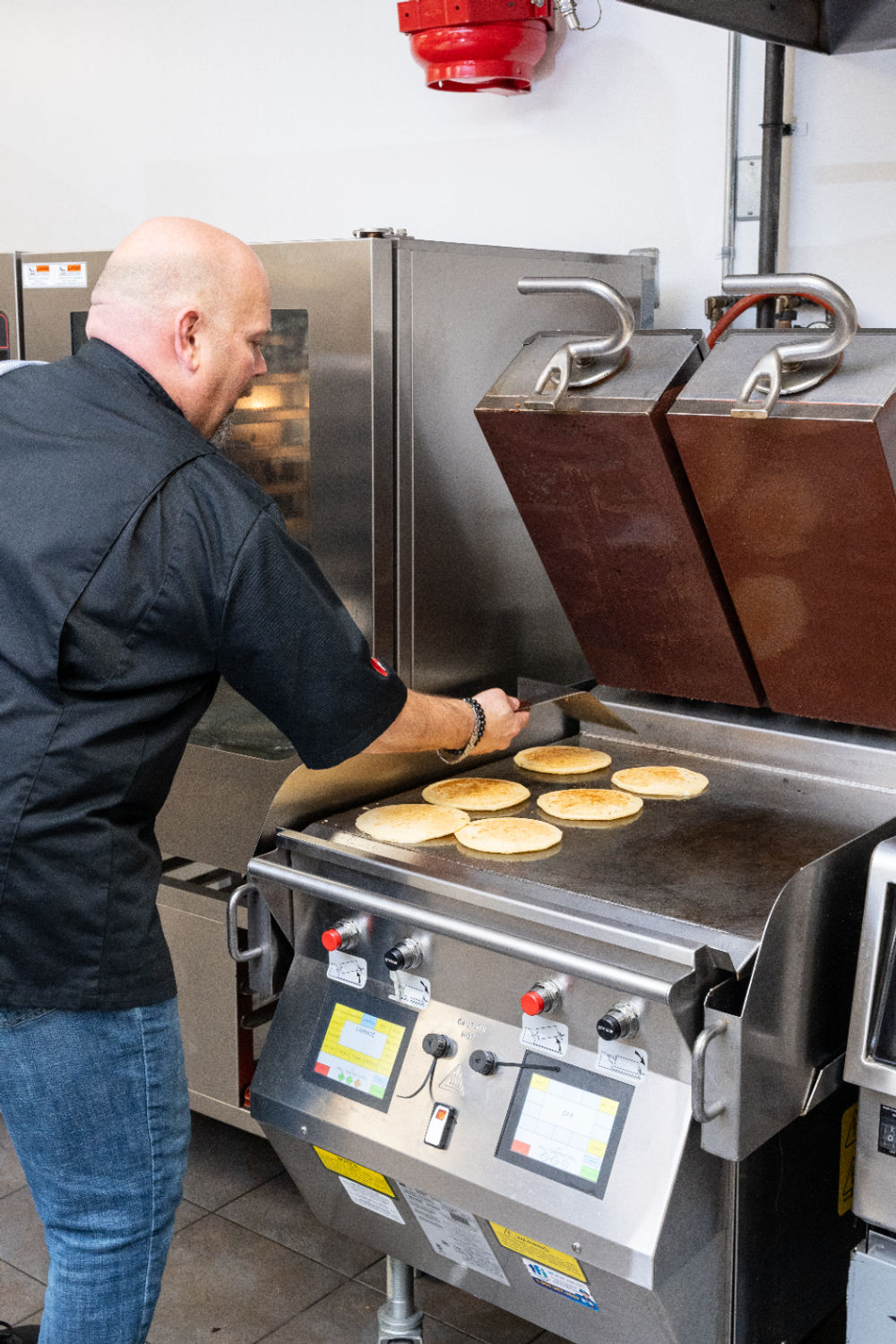
Thermostatic vs Manual Griddle Controls
Manual controls set how much heat goes in, while thermostatic controls hold the plate at a set temperature. For any griddle that runs through a rush, thermostatic control is worth the extra cost.
Control type | How it works | Strong fit |
|---|---|---|
Manual | A gas valve or electric switch sets heat input; plate temperature drops when cold product lands, and the cook adjusts by feel | Low-volume sites, simple menus, tight budgets |
Thermostatic | A sensor under the plate cycles heat to hold a set temperature and recovers automatically after a load | Most restaurants and QSRs; delicate items like eggs and fish |
Programmable (Taylor L800 series) | Separate top and bottom set points per menu item, plus cook time, gap, and multi-stage sear and turn prompts | Multi-unit brands, high-volume proteins, crews with high turnover |
Thermostatic control also affects energy cost. ENERGY STAR's griddle specification covers "single- and double-sided gas and electric models that are thermostatically controlled," so a manual-control griddle cannot earn the label.
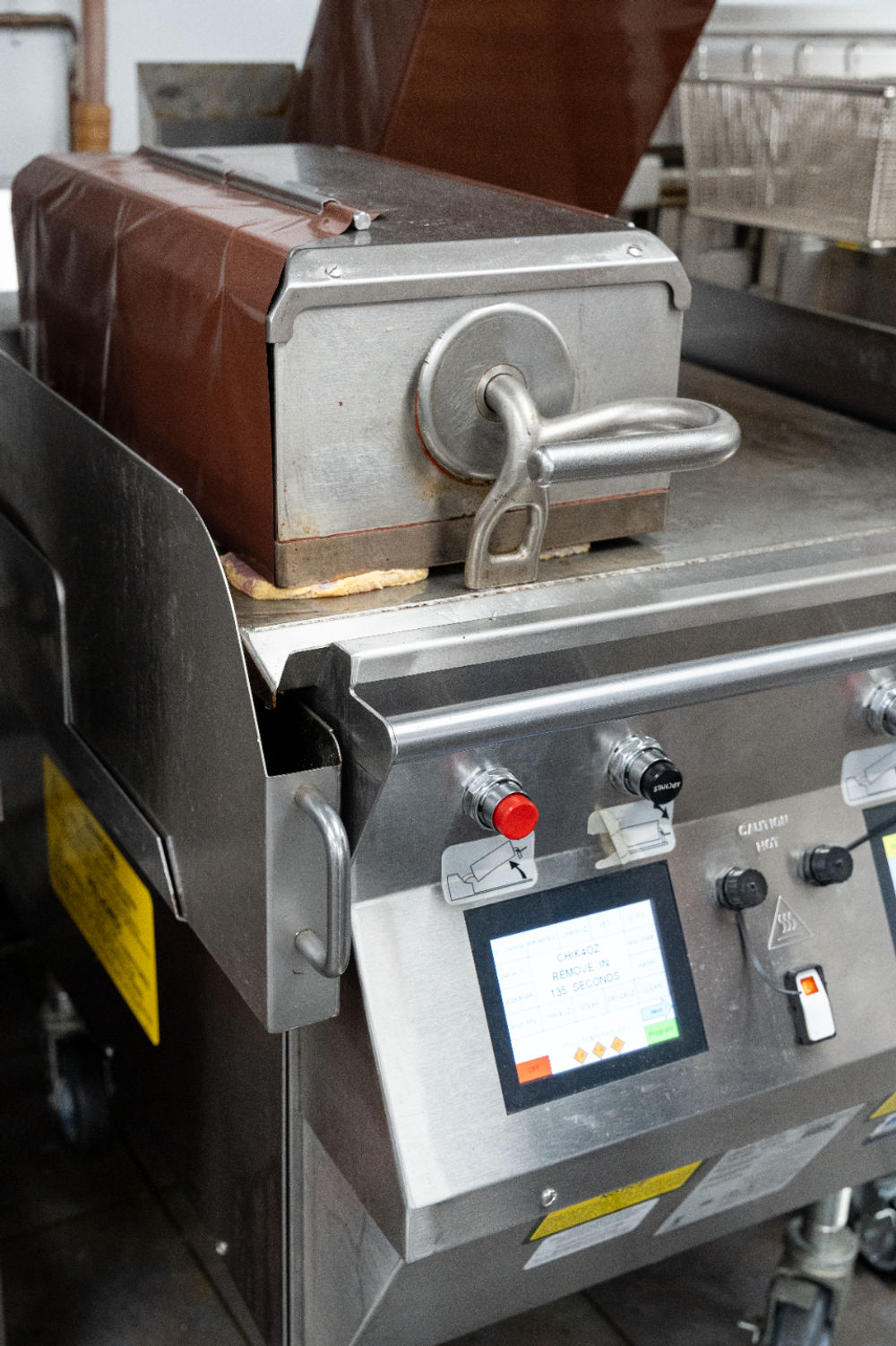
Commercial Griddle Cleaning: A Daily Routine That Protects the Plate
Clean a commercial griddle lightly after every run and fully once a day. The routine is slightly different for a single-sided flat top and for a two-sided grill with release sheets, and your manufacturer's manual always takes priority over general advice.
Single-sided flat top griddle cleaning
After each load, scrape the plate while it is warm and push debris into the grease trough.
During and after each shift, empty the grease trough or drawer before it fills.
Once a day, apply the manufacturer's approved griddle cleaner to a warm (not hot) plate, scrub with the pad the manufacturer allows, squeegee, and wipe clean. Chrome plates scratch under abrasives, so check the manual first.
Re-season steel plates with a thin film of oil after the daily clean.
Never cool the plate with cold water or ice. The sudden temperature change can damage the plate.
Taylor two-sided grill cleaning
Taylor's operator manual sets out a specific routine for the L800 series. After each run of product, scrape grease on the lower surface from front to back with the grill scraper, squeegee the release sheet with light downward strokes, and push grease at the rear into the grease can with the squeegee. Wipe the release sheets with a clean, sanitizer-soaked grill cloth at least four times an hour.
The daily clean follows this sequence:
Press CLEAN and wait for the alarm and the READY TO CLEAN message.
Remove the release sheets and clean both sides on a flat surface. Never fold, crease, soak, or hot-hose them.
Scrape the lower surface, squeegee the grease into the cans, then empty the cans.
Apply about 3 oz (90 mL) of approved high-temperature grill cleaner to each 12-inch cook zone and scrub the platens and plate with Taylor's non-abrasive pad and holder. Do not use metal scrapers, abrasive pads, grill screens, or wire brushes.
Rinse with sanitizer-soaked cloths and lukewarm water poured onto the cloth. Never use a jet of water, cold water, or ice, which Taylor warns can cause electrical shock, steam burns, and damaged cook surfaces.
Rotate the release sheets daily, reinstalling them on the opposite colour side. Non-24-hour stores finish with a light coat of vegetable oil on the lower surface.
Our step-by-step Taylor grill cleaning guide walks through the full routine with photos from TFI's technician training video.

Installation, Service and Financing in Ontario and Atlantic Canada
How well a commercial griddle performs depends on how it is installed and who services it. TFI has supplied Canadian foodservice for more than 60 years and handles Taylor grill projects across Ontario, Nova Scotia, New Brunswick, Prince Edward Island, and Newfoundland and Labrador. A typical project covers four steps:
Site survey to confirm gas, electrical capacity, hood length, and the clearances listed above.
Model selection matched to your peak-hour covers and menu mix.
Installation and start-up, including crew training on programming, flat and clamshell modes, and the daily clean.
Ongoing support from TFI's factory-trained repair technicians, with OEM parts for Taylor equipment.
A two-sided grill costs more upfront than a single-sided griddle. Leasing, lease-to-own, and rental options spread that cost over the period the grill pays it back. Our restaurant equipment financing guide for Canada covers the options.
Commercial Griddle Buying Checklist
Question | What to check |
|---|---|
Gas or electric? | Existing gas service, spare electrical capacity, and the fact that Taylor gas models still need a dedicated electrical connection |
What width? | Peak-hour grill covers, using the sizing table above |
Will it fit? | Unit depth, hood length, 34-inch aisle clearance, and 3-inch flue clearance on gas models |
Single-sided or clamshell? | Share of volume in repeatable proteins versus made-to-order variety |
What controls? | Thermostatic at minimum; programmable for multi-unit consistency |
Energy cost? | ENERGY STAR status (Taylor L810, L811, L812, L813) and standby features |
Cleaning plan? | Approved cleaner, pads, release sheet stock, and a written closing routine |
Service? | Factory-trained technicians and OEM parts close to your kitchen |
Frequently Asked Questions
What is the difference between a griddle and a flat top grill?
There is no practical difference. In commercial foodservice, griddle, flat top grill, flat grill, and flat top griddle all describe a flat metal plate heated from below. The meaningful distinction is between a single-sided griddle and a two-sided clamshell grill, which adds heated upper platens that cook the top of the food at the same time.
Is a gas or electric commercial griddle better?
Neither is better in every kitchen. Gas suits sites that already have gas service, and propane works for rural and seasonal locations. A commercial electric griddle suits kitchens without a gas line, as long as the electrical service can carry the load. ENERGY STAR estimates certified electric griddles are 17% more efficient than standard models and certified gas griddles 14% more efficient, so compare certified units at your local utility rates.
What size commercial griddle do I need?
Size to your busiest hour. As a starting point, 30 to 60 peak-hour grill covers fits a 24-inch single-sided griddle, 60 to 100 fits 36 inches, 100 to 200 fits 48 inches, and 200 to 350 fits 60 inches. Because Taylor two-sided grills cut cook times by up to 50%, a Taylor unit can usually be one size class narrower, for example a 24-inch L819 or L820 in place of a 36-inch flat top.
What is a clamshell grill?
A clamshell grill is a commercial griddle with one or more heated upper platens that close over the food, cooking both sides at once without flipping. Taylor's L800 series clamshell grills use automatic gapping and programmable controls, so every product cooks at the same gap, time, and temperature on every cycle.
Can a Taylor two-sided grill be used as a regular flat top griddle?
Yes. Each menu item on a Taylor L800 series grill is programmed as CLAM or FLAT. In flat mode the upper platens stay raised and product cooks on the lower surface only, with up to four flat items timed in one zone at once. That lets one unit handle eggs, bacon, onions, and buns alongside two-sided burger and chicken cooking.
How hot does a commercial griddle get?
It depends on the model, so check the spec sheet. On Taylor's L800 series, the lower surface can be programmed from 150°F to 400°F (66°C to 204°C) and the upper platen from 150°F to 450°F (66°C to 232°C), with separate set points for each menu item.
How do you clean a commercial griddle?
Scrape after every load, empty the grease trough during the shift, and do a full clean once a day with the manufacturer's approved cleaner, then re-season steel plates with a thin film of oil. On Taylor two-sided grills, use the Clean mode, clean the release sheets on both sides, apply about 3 oz (90 mL) of cleaner per 12-inch zone, and never use cold water, ice, or a jet of water.
Are Taylor two-sided grills ENERGY STAR certified?
Taylor's spec sheets list the L810, L811, L812, and L813 as ENERGY STAR qualified at 208V or 240V, 60 Hz. Every L800 series model also has a standby alert, which Taylor says reduces operating energy by up to 40% compared with full operation mode when a platen is idle.
Choosing the Right Commercial Griddle for Your Kitchen
The right commercial griddle is sized to your peak hour, matched to the utilities you already have, and backed by service close to your kitchen. For breakfast-heavy or low-volume menus, a thermostatic single-sided flat top is often enough. For burger, chicken, and breakfast sandwich volume, a Taylor L800 series two-sided grill turns the same plate into more covers per hour, with programmed consistency your whole crew can run.
TFI's equipment specialists can model your peak hour, check your gas and electrical service, and match you to the right Taylor model. Request a free quote or demo to get started.
References
Taylor Company, accessed September 2026. Commercial two-sided grills. Taylor
Taylor Company, accessed September 2026. L800 series specification sheets: L810, L811, L812, L813, L819, L820, L821, L828
Taylor Company, accessed September 2026. Operator manuals, gas series (811, 813, 819, 821) and electric series (810, 812, 820, 822, 828). Gas series, Electric series
Taylor Company, accessed September 2026. Model L812 electric two-sided grill. Taylor
Taylor Freezer of Connecticut, accessed September 2026. Two-sided platen grills. Taylor Freezer of Connecticut
ENERGY STAR, accessed September 2026. Commercial griddles. ENERGY STAR
Statistics Canada, 2026. Food services and drinking places, December 2025. Statistics Canada
Restaurants Canada, 2025. Canada's 2025 dining trends. Restaurants Canada

Nicole Camposeo-Cheung is the Director of Marketing, People & Culture at TFI Food Equipment Solutions, Canada’s leading provider of premium commercial foodservice equipment. She combines her expertise in business management and fashion arts to foster a dynamic, innovative, and people-centric corporate culture. Passionate about empowering teams, building strong client relationships, and driving growth through creativity and collaboration, Nicole plays a key role in shaping TFI’s brand and workplace culture. She also shares her industry expertise and insights through the TFI blog, helping foodservice professionals stay informed about the latest trends, best practices, and innovations in commercial food equipment.
Add a comment
This will be publicly visible.
Your email address will not be published.
Your comment will be reviewed by an admin before it is published.


