
Commercial Espresso Machines in Canada: What They Cost Up Front and Per Cup
What a commercial espresso machine costs to buy and per cup in Canada, how many group heads you need, and which Franke model fits your daily volume.

A commercial espresso machine in Canada is priced on throughput rather than badge: what you pay depends on the cups you need at peak, the group heads or bean hoppers that takes, and whether a person or the machine does the work. The number that decides whether the programme earns money is different, and smaller. It is the cost per cup once staff time is counted.
Ingredients for a medium milk drink run roughly 40 cents. Labour, at Canada's current counter wage, can cost almost as much again on a traditional machine and next to nothing on a super-automatic. That gap of about 32 cents per cup is worth roughly $15,000 a year at 150 cups a day, and it is the single largest variable most operators leave out of the comparison.
This guide walks the four decisions in order: what drives the purchase price, what each cup costs to make, how much machine you need, and how to acquire it. If you would rather skip to a modelled number for your own volume, TFI's team will build the costing with you. The Franke models compared below are on TFI's Franke A Series commercial coffee machines page.
How much does a commercial espresso machine cost?
Purchase price tracks four things: daily cup capacity, the number of group heads or bean hoppers, the degree of automation, and the milk system. A single group traditional machine for a bakery sits at the bottom of the range. A three group traditional machine or a top-tier super-automatic with two milk types and a flavour station sits at the top, often several times higher.

Rather than quote a range that will not match your site, TFI models the full installed cost against your real volume. The payback arithmetic matters more than a range anyway. TFI's own figure for the Franke A Series is that selling just five to seven cups a day covers a typical monthly lease payment, which is why leasing and financing is the route most independent operators take rather than a capital purchase.
Context for the spend: 71% of Canadians reported drinking a coffee beverage the previous day in the Coffee Association of Canada's most recent study, with 29% having an espresso-based drink. Espresso-based consumption has climbed from 24% in 2023. The demand is there. The equipment decision is about capturing it profitably.
Commercial espresso machine cost per cup, with labour counted
Cost per cup is ingredients plus the staff time each drink consumes. Ingredients are near-identical whichever machine you buy. Labour is not, and that is where the two machine types separate.
Published data for a medium cappuccino is a $3.50 in-cup price against roughly 40 cents of variable cost covering beans, milk, cup and lid. Hold that constant and add labour. Statistics Canada put the average offered hourly wage for food counter attendants and kitchen helpers at $17.60 in the first quarter of 2026, up from $17.15 a year earlier. That is also Ontario's current general minimum wage, rising to $17.95 on 1 October 2026.

At $17.60 an hour, a minute of staff time costs about 29 cents. A barista on a traditional machine grinds, doses, tamps, locks in, extracts, steams milk, pours and wipes down. Allow 75 seconds of hands-on time. A super-automatic takes a cup placement and a button press: allow 10 seconds.
Cost component | Traditional or semi-automatic | Super-automatic |
|---|---|---|
Ingredients: beans, milk, cup, lid | $0.40 | $0.40 |
Hands-on staff time per drink | ~75 seconds | ~10 seconds |
Labour at $17.60 per hour | $0.37 | $0.05 |
Total cost per cup | $0.77 | $0.45 |
Gross margin at a $3.50 in-cup price | 78% | 87% |
The labour figures above are illustrative, built from the wage rate cited and the hands-on times stated, not measured on your line. Change the assumptions and the conclusion holds anyway: automation removes roughly 30 cents of labour from every milk drink.
Scaled across a trading year, that 32 cent gap is worth about $15,000 at 150 cups a day and roughly $25,000 at 250 cups a day.
This is the mechanism behind the 80%-plus gross profit per cup and six to twelve month payback TFI quotes on Franke programmes. The margin does not come from cheaper beans. It comes from taking the labour out.
Two things make the labour side harder to ignore in 2026. Restaurants Canada found 89% of operators citing labour costs as a top concern, up from 80% six months earlier. And Statistics Canada recorded vacancies for food counter attendants and kitchen helpers rising by 1,500 to 24,400 in the first quarter of 2026, one of the few occupation groups where vacancies grew. Counter roles remain difficult to fill even as the broader labour market loosens.
Green coffee prices add pressure from the other direction. The International Coffee Organization's composite indicator averaged 248.90 US cents per pound in June 2026, well below the record 343.08 cents set between February and May 2025 but still historically high. With bean costs elevated and 41% of Canadian restaurants operating at a loss or breaking even, the controllable cost on a coffee programme is labour.
What makes an espresso machine commercial grade?
A commercial grade espresso machine is built for continuous duty rather than a few drinks a day. Four things separate it from a prosumer unit:
Boiler capacity and recovery. Domestic machines use a single small boiler that cannot brew and steam at once without a temperature drop. Commercial machines use heat exchangers or separate boilers so extraction temperature holds while milk is steaming. The Franke S700 runs a three-boiler system for exactly this reason.
Plumbed water and drainage. A reservoir is a domestic feature. Commercial machines connect to a water line with filtration and a drain, which is what lets them run all day without intervention.
Electrical supply. Higher-volume machines draw more than a standard 120-volt circuit provides and need dedicated service.
Certification. Equipment installed in a Canadian commercial kitchen must carry CSA or equivalent certification and satisfy your local public health authority. This is not optional, and it is a common reason imported bargain units cannot be commissioned.
Duty cycle is the practical test. A machine rated for 100 cups a day will physically produce 200, briefly, and then fail early. Sizing to your real peak is cheaper than replacing a boiler in year two. TFI's technicians assess site services as part of any quote, so the electrical and plumbing questions get answered before the machine arrives.

How many group heads do you need: 1, 2, or 3 group machines?
On a traditional machine, each group head extracts one shot cycle at a time, so group count sets your theoretical ceiling. A group running a 30-second double shot could in principle produce 120 shots an hour. Real output never approaches that, because the same barista also has to steam milk, pour, and serve. Milk is the bottleneck in almost every café, not extraction.

Configuration | Typical fit | What limits real output |
|---|---|---|
1 group traditional | Offices, bakeries, dining rooms where espresso is a secondary item | One person doing every step; a second group would not help |
2 group traditional | Cafés and restaurants with a defined morning peak | Staffing. A second group only pays off with a second pair of hands on bar |
3 group traditional | High-volume specialty cafés running two or more baristas at peak | Floor space and labour cost rather than the machine |
Super-automatic | Offices, hotels, c-stores, QSR, restaurants, any self-serve setting | Grinder and brew unit cycle time, plus bean and milk refills |
Super-automatics have no group heads, which is why comparing them to a two group machine on that basis misleads. They are rated on cups per hour and cups per day instead, and those figures are independently standardised. Franke publishes capacity to DIN 18873, so an A800 rated at 160 espressos an hour single-cup is a certified figure rather than a marketing claim.
For most Canadian operators the honest sizing question is not how many groups, but whether a group head belongs in the plan at all. If nobody on your roster is a trained barista, group count is irrelevant.
Super-automatic vs traditional commercial espresso machines
The short version: traditional machines give a skilled barista control over every variable and depend entirely on that skill being present on every shift. Super-automatics trade that ceiling for consistency, throughput and training time measured in minutes.

Choose traditional if espresso craft is your differentiator, you can staff trained baristas reliably, and customers are paying a premium for latte art and single-origin dialling-in. Choose super-automatic if consistency across shifts matters more than ceiling quality, labour is your constraint, or the machine will be used by staff whose main job is something else. That covers most offices, hotels, convenience stores, quick service restaurants and full service dining rooms.
We have argued this comparison out in full elsewhere, including training time, drink quality and barista dependency: see super-automatic vs traditional commercial espresso machines for the detailed treatment. If you want the mechanics of what a super-automatic is doing inside the cabinet, how bean-to-cup machines work covers the grind, dose and brew cycle.
The market is moving one way. Van Houtte's Jon Theisen told Convenience & Carwash Canada that lattes and cappuccinos are "moving well beyond the café," with operators investing in espresso and bean-to-cup machines to deliver a coffee shop experience. Michael Cheung, president of TFI Food Equipment Solutions, described the shift in self-serve coffee as moving from "cheap coffee fast" to "fast coffee that's actually good".
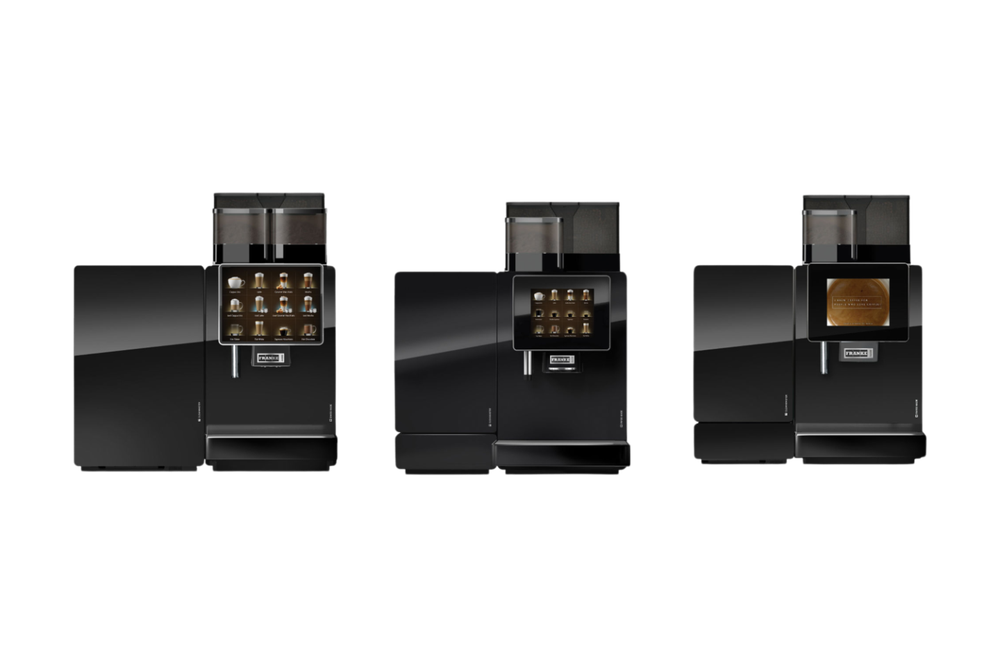
Commercial automatic espresso machine options: Franke A Series and S700
TFI supplies Franke super-automatic and semi-automatic systems across five capacity tiers. Every figure below is Franke's published specification.
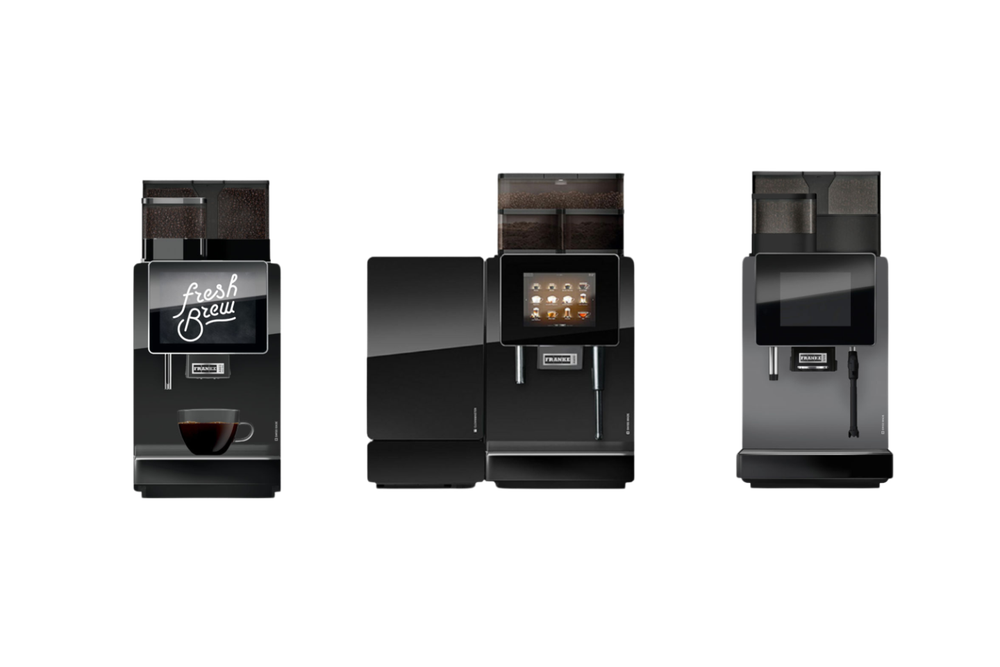
Franke model | Published daily capacity | Espresso per hour, DIN 18873 | Bean hoppers | Milk system | Touchscreen |
|---|---|---|---|---|---|
Up to 100 cups | Not published | 2 | FoamMaster, one milk type | 8 inch | |
Up to 150 cups | Not published | 2 | FoamMaster, one milk type | 8 inch | |
Up to 250 cups | 160 single, 238 parallel | 3 | FoamMaster | 10.4 inch | |
Up to 300 cups | 160 single, 238 parallel | 2, third to order | FoamMaster, up to two milk types | 10.4 inch | |
Up to 300 cups | Not published | 3 plus one powder | FoamMaster, up to two milk types | 10.4 inch | |
Up to 250 cups | 160 single, 138 parallel | 2 | Autosteam and Autosteam Pro | 8 inch |
Three notes on reading that table. The 250 cup daily figure is published for the A800 Fresh Brew variant specifically. The per-hour figures come from Franke's A800 and A1000 product leaflets and are measured to DIN 18873, with "parallel" meaning two cups drawn at once. And the S700 is semi-automatic: it automates extraction with iQFlow and assists milk texturing with Autosteam, while a barista still handles the milk jug, which is why it appears in specialty cafés that want consistency without giving up the bar entirely.
Every A Series cabinet is 340 mm wide, which matters more than most spec lines when you are fitting a machine behind an existing counter. For model-level comparison of the A Series, including which tier suits which volume, see the Franke A Series comparison and the closer read on A600 vs A800 vs A1000. Full product detail sits on the Franke A Series and Franke S Series pages.
Choosing a commercial espresso machine by venue type
Match the machine to your daily cup count and to who will be operating it. Those two variables decide almost every specification.
Specialty cafés. Espresso is the product. A two or three group traditional machine, or an S700 where consistency across shifts matters, backed by trained staff. If you are still building out, the coffee shop equipment checklist covers what else the bar needs.
Restaurants and hotels. Coffee arrives at the end of service when the kitchen is busiest and nobody has 75 seconds to spare. Super-automatic, sized to covers rather than to a morning peak. An A600 handles most dining rooms.
Offices and institutional sites. No trained operator, variable demand, and quality expectations that have risen sharply. An A400 or A600 fits, and automatic coffee machines for offices breaks down sizing by headcount.
Convenience stores and QSR. Self-serve, unattended, high peak volume, payment integration. An A800 Fresh Brew or A1000 with a flavour station. Segment-level margin and payback numbers sit in commercial coffee programme ROI by segment.
Multi-site operators. Standardise the model across locations so training, parts and service are common. The bean-to-cup programme guide covers rollout across cafés, QSR and c-stores.

Reading demand before you specify helps: coffee trends in Canada tracks what Canadians are ordering, which is what your drink menu and therefore your milk and flavour requirements follow from.
New, used, or leased: how to acquire an espresso machine in Canada
Four routes, each suiting a different balance sheet.
Buy new. Full warranty, current technology, highest up-front cost. Right for established operators with capital and a known volume.
Certified used. A used commercial espresso machine from a dealer that refurbishes and warranties it is a legitimate way into a programme at lower cost. The risk with private-sale machines is boiler scale and undocumented service history, neither of which is visible in a photograph.
Lease or lease-to-own. The common route, because it matches the cost to the revenue the machine generates from month one. Options and monthly cost structures are laid out in coffee machine rental in Canada.
Rent. Short-term, seasonal or event use, or a trial before committing. See commercial espresso machine rental for terms.
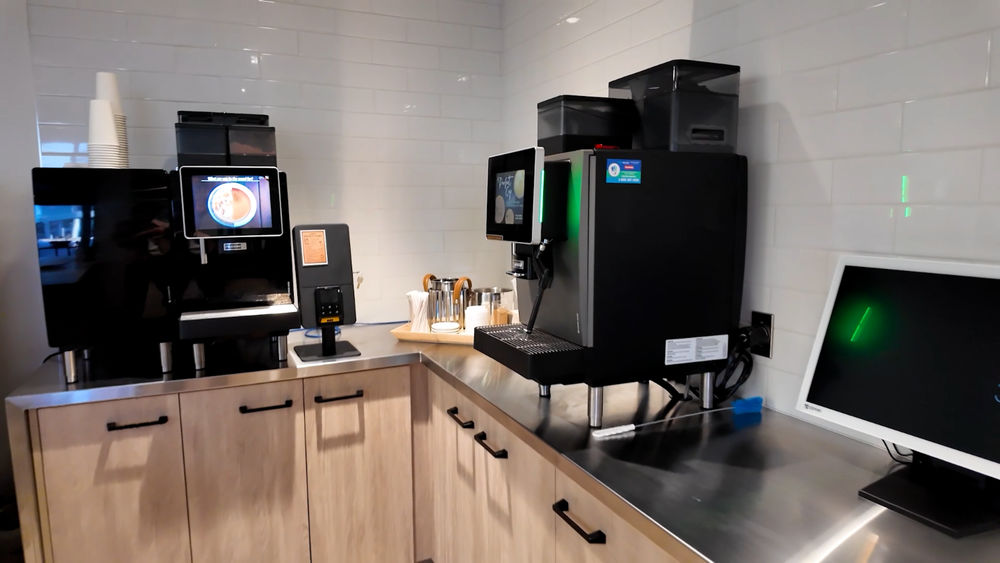
Before any of these, test the machine on your own menu. TFI runs chef demos at its Mississauga showroom where you can pull drinks on the actual model you are considering.
Commercial espresso machine maintenance and uptime
These machines fail from scale and milk residue far more often than from mechanical wear. Two routines prevent nearly all of it.
Descaling frequency depends on water hardness and volume, not on a calendar. Machines on filtered and softened water in soft-water areas go far longer between descales than unfiltered machines in hard-water municipalities. Franke's A Series automates the daily side through CleanMaster, and the A800 uses EasyClean, which is why automated cleaning cycles are a genuine labour saving and not just a spec line. Milk systems need daily cleaning without exception.
When something does go down mid-service, coffee is usually the highest-margin item on the menu, so downtime is expensive. TFI's factory-trained technicians cover commercial kitchen equipment repair across Ontario and Atlantic Canada, and TFI Total Care rolls planned maintenance, parts and repairs into one predictable monthly cost with no overtime surcharges. GTA operators can read the local detail in commercial espresso machine repair in Toronto.
Commercial espresso machine FAQ
How much does a commercial espresso machine cost?
Price is driven by daily cup capacity, group head or bean hopper count, automation level and milk system, so a single group traditional machine and a top-tier super-automatic sit several multiples apart. Budget for installation and water treatment on top of the machine. Because coffee margins are high, most operators finance rather than buy outright: TFI's figure for the Franke A Series is that five to seven cups a day covers a typical monthly lease payment.
What is a super automatic espresso machine?
A super-automatic grinds, doses, tamps, extracts and textures milk in one automated cycle triggered by a single button or screen selection. The operator places a cup and makes a choice. Training takes minutes rather than weeks, and every drink comes out to the same recipe regardless of who is on shift.
How do you choose a commercial espresso machine?
Work through four questions in order: how many cups at your busiest hour and across a full day, who will operate it and how trained they are, what drinks the menu requires including milk types and flavours, and what services the site has for water and power. Capacity and operator skill together eliminate most of the options before price enters the conversation.
How often should you descale a commercial espresso machine?
Frequency follows water hardness and throughput rather than a fixed interval. Proper filtration and softening at installation extends the interval substantially and is the single most effective thing you can do to protect a boiler. Your service provider should set a schedule based on a water test at your site, and daily milk system cleaning is separate and non-negotiable.
Is a used commercial espresso machine worth buying?
A certified used machine from a dealer that has refurbished it and stands behind it with a warranty is a sound way to lower entry cost. A private-sale machine with no service records is a different proposition, because scale damage and worn boilers are not visible externally and repair can exceed the saving.
What is the best commercial espresso machine for a small coffee shop?
For a small shop with trained baristas, a two group traditional machine or a Franke S700 covers a morning peak while holding quality. For a small shop where the owner is also serving, baking and running the till, a Franke A600 at up to 150 cups a day removes the labour bottleneck entirely. Our buyer's guide for coffee shops works through the café-specific trade-offs.
Can you rent an espresso machine for commercial use in Canada?
Yes. TFI offers rentals for short-term, seasonal and event use, alongside leasing and lease-to-own for permanent installations. Renting first is a practical way to validate demand before committing capital, particularly for a new location or a seasonal patio programme.
Where to buy a commercial espresso machine in Ontario and Atlantic Canada
TFI Food Equipment Solutions has supplied Canadian foodservice for more than 60 years, with an equipment showroom in Mississauga and a second in Dartmouth, Nova Scotia, serving operators across Ontario, Nova Scotia, New Brunswick, Prince Edward Island, and Newfoundland and Labrador. The same team sells the machine, installs it, trains your staff and services it afterwards, which matters on equipment where a day of downtime costs more than a month of maintenance.
Bring your peak-hour cup count and your drink menu, and ask our team to model the cost per cup for your site. If the numbers work, they work on paper first.

Nicole Camposeo-Cheung is the Director of Marketing, People & Culture at TFI Food Equipment Solutions, Canada’s leading provider of premium commercial foodservice equipment. She combines her expertise in business management and fashion arts to foster a dynamic, innovative, and people-centric corporate culture. Passionate about empowering teams, building strong client relationships, and driving growth through creativity and collaboration, Nicole plays a key role in shaping TFI’s brand and workplace culture. She also shares her industry expertise and insights through the TFI blog, helping foodservice professionals stay informed about the latest trends, best practices, and innovations in commercial food equipment.
Add a comment
This will be publicly visible.
Your email address will not be published.
Your comment will be reviewed by an admin before it is published.


